Key Takeaways
- Most thin, flat, random slab cracks come from concrete drying and shrinking. They rarely threaten the structure.
- A crack where one side sits higher, or that keeps widening, or that shows up with sticking doors or cracked tile, needs a licensed engineer's in-person look.
- Track the crack with dated photos and marks, and check for water problems first. Then get a diagnosis before anyone patches, drills, or replaces concrete.
Most cracks in Los Angeles concrete slabs come from shrinkage. They’re thin and flat, and the structure doesn’t care about them. A slab foundation crack structural enough to need attention usually comes with warning signs you can see. One side may sit higher than the other, the crack may keep getting wider, or doors and tile may start acting up at the same time. Looks alone can’t settle the question, though. If you see those signs, have a California-licensed engineer look at the slab in person before anyone patches, drills, or tears out concrete.
What makes a slab foundation crack structural instead of shrinkage?
Shrinkage cracks are usually thin, level across both edges, and random or web-shaped. Cracks that need an engineer's look tend to be wider, offset, growing, or lined up with other damage in the house.
Start with the pattern. Shrinkage often makes a spiderweb of fine lines, called map cracking, or one straight hairline running across a room or garage. Settlement cracks tend to run diagonally from a corner, follow a line where the soil underneath behaves differently, or show up together with cracks in the walls above.
Next, look at width and the two edges. Contractors and inspectors often use rough rules of thumb. A crack thinner than about 1/8 inch with level edges is usually treated as cosmetic. Anything wider than about 1/4 inch gets a closer look. These numbers aren’t code or an engineering standard. They’re shorthand for deciding when to ask a professional.
Location matters too. A crack at an inside corner of the slab, where an L-shaped house turns, is common, because concrete pulls apart where the shape changes. A crack that runs under a bearing wall, or splits right where a post or column sits, deserves more attention.
Finally, think about the age of the slab and what’s around the crack. A hairline in a two-year-old garage floor is a different story from a crack in a 1960s slab that suddenly opened after a wet winter.
Is it normal for a newer slab to crack, and how long does shrinkage keep going?
Yes, newer slabs crack often, because concrete loses water and shrinks as it dries. That drying doesn't stop after the first month. It slows down over time but can continue for years.
Concrete is mixed with more water than it needs to harden. As the extra water leaves, the concrete gets smaller. The soil underneath and the walls on top hold the slab in place, so the concrete can’t shrink freely. When that pulling force gets stronger than the concrete, it cracks.
The American Concrete Institute’s guide to controlling cracking in concrete explains that slabs on the ground dry from the top surface first. That uneven drying makes the edges curl up slightly, which adds stress and more cracks. The guide also explains why keeping new concrete moist for the first several days helps limit cracking.
Here’s the part most online articles get wrong. A crack on a young slab that widens a little over a year or two isn’t automatically a sign of settlement. Slow drying can do that on its own. What matters is whether the edges stay level and whether anything else in the house is changing at the same time.
Control joints help too. These are the straight grooves cut or tooled into slabs so cracks form there instead of at random. A crack running in or next to a control joint is usually the joint doing its job.
What does it mean if one side is higher or the crack keeps getting wider?
A height difference between the two sides, called offset, means part of the slab has moved up or down. Steady widening, especially with sticking doors or cracked tile, points to movement in the soil or structure rather than simple drying.
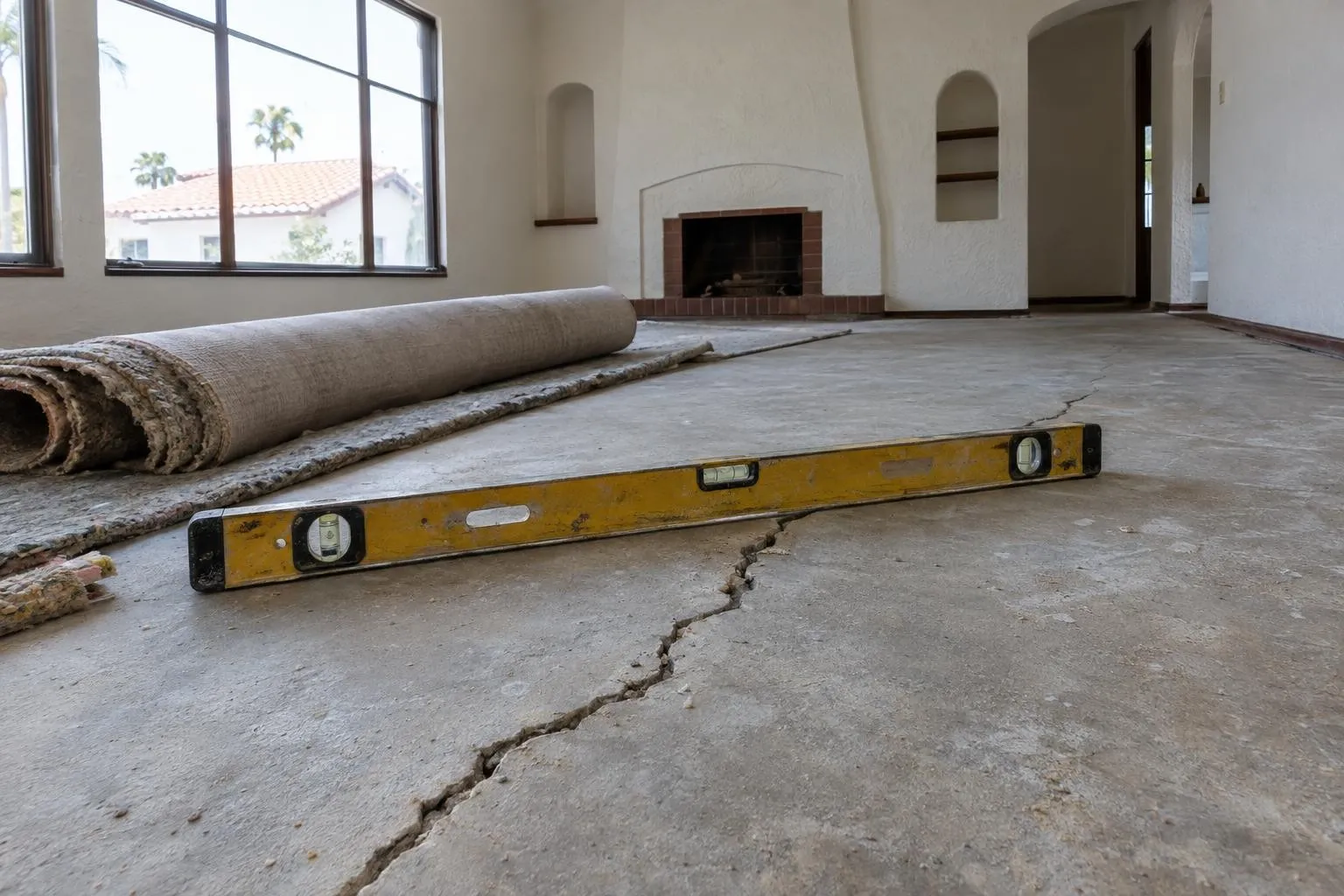
Run your fingers or a straightedge across the crack. If one side catches your nail or a coin sits unevenly, you have offset. Shrinkage pulls concrete apart sideways. It doesn’t usually lift one side. Offset suggests the soil under one part of the slab is swelling, settling, or washing out.
Look around the rest of the house. Doors that suddenly stick or swing open by themselves, gaps at the tops of door frames, diagonal drywall cracks from window corners, and floor tile cracking in a line are all clues. When those show up near a slab crack, the crack is probably part of the same movement. Our guide to signs of foundation settlement in LA homes walks through those clues in more detail.
In older Los Angeles homes, the tile or wood flooring is often the first thing to tell you. You may not see the slab under carpet, but a long crack running through tile usually mirrors a crack in the concrete below.
None of these signs by itself proves a slab foundation crack structural. They tell you it’s time for a professional, not a tube of caulk.
Could water under or around the house be causing the crack?
Yes. Water is one of the most common reasons soil under a slab moves. Leaking pipes, downspouts that dump next to the house, heavy irrigation, and yards that slope toward the walls all deserve a check before any crack repair.
A slab leak is a leak in a water or drain line running through or under the concrete. Warning signs include a warm spot on the floor, the sound of running water when everything is off, a water meter that keeps spinning, or a water bill that jumps for no reason. A leak can soften or wash out soil for months before anyone notices.
Outside, walk the house after it rains. These are the usual trouble spots:
- Downspouts that empty right at the foundation instead of several feet away.
- Planters and sprinklers soaking the soil against the wall.
- Patios or soil that slope toward the house, so water runs back under the slab edge.
- Large trees close to the house, whose roots pull moisture from the soil and make it shrink unevenly.
Fixing the water comes first. If you inject or patch a crack while a leak or a soaked planter keeps moving the soil, the crack will usually come back right next to the repair.
Does Los Angeles clay soil or a hillside lot change the risk?
Yes. Much of Los Angeles sits on expansive clay that swells in wet winters and shrinks in dry summers, and that cycle can crack slabs. Hillside lots add slope movement and drainage problems, and earthquakes can crack concrete anywhere.
Expansive clay is soil that grows when it gets wet and shrinks when it dries. Our weather follows a long dry season and a short wet one, so the soil under a slab edge can rise and drop every year. Cracks that open in late summer and close a bit in winter often point to clay movement.
On a hillside, soil can creep slowly downhill. Water can also collect against the uphill side of the house. Slab cracks that run parallel to the slope, or that sit on the downhill side, need closer attention. Good drainage matters a lot here, and our article on planning hillside foundation drainage explains how water should move around a sloped lot.
Earthquakes can crack slabs too, sometimes in ways that look exactly like shrinkage. If a crack appeared or changed after a quake, write down the date and take photos right away. Whether a policy covers slab cracking depends on the policy and on what caused the crack. The California Earthquake Authority explains how residential earthquake coverage works, so read your own policy and ask your insurer before assuming anything.
How do I track a crack so an engineer can understand it?
Take dated photos with a ruler in the frame, mark the ends of the crack, and check it on a regular schedule. A few months of records tell an engineer far more than one snapshot.
Whether a slab foundation crack structural or cosmetic is often decided by one thing: is it moving? Tracking answers that, and it costs almost nothing.
- Clean the crack and photograph it straight on, with a ruler or tape measure lying across it. Take one close-up and one wider shot that shows where it is in the room.
- Mark each end of the crack with a pencil line and write the date next to it. If the crack grows longer, you’ll see it pass your mark.
- Measure the widest point. A simple plastic crack-width card works, and so does a crack monitor, a small two-piece gauge screwed across the crack that shows movement in both directions.
- Check whether the two edges are level, and note any offset.
- Repeat every month or so, at about the same time of day, and note the weather. Include changes to doors, windows, and tile.
- Keep everything in one folder or phone album so you can hand it to an engineer.
An engineer may also do a floor-level survey, which measures how flat the floor is from room to room. That shows whether part of the house has dropped or risen. Our foundation inspection checklist for Los Angeles properties covers what a full evaluation usually looks at.
Is my slab post-tensioned, and why does that matter before anyone drills?
Some newer Los Angeles-area homes sit on post-tensioned slabs, which have steel cables inside the concrete pulled very tight. Cutting or drilling into one of those cables can be dangerous and expensive, so the slab should be scanned before anyone drills, saws, or injects.
A post-tensioned slab, often called a PT slab, has steel cables, called tendons, running through it. After the concrete hardens, the tendons are stretched and locked off, squeezing the slab together so it resists cracking. Not every newer home has one, but they’re common in tract housing built in the last few decades.
Look for clues. Builders often stamp the garage slab or post a notice saying the slab is post-tensioned and shouldn’t be cut or drilled. You may also see a row of small patched pockets along the slab edge, where the tendon ends were sealed. Your original building plans, if you can get copies, will usually say too.
If your slab might be PT, nobody should drill an anchor, cut a trench, or inject a crack until the tendons are located. Crews usually use ground-penetrating radar, a scanner that shows what’s inside the concrete. The Post-Tensioning Institute publishes guidance on working safely around these slabs.
Cracks in PT slabs tend to be fewer and tighter, so a wide or offset crack in one deserves an engineer’s attention sooner rather than later.
Who should diagnose the crack, an engineer or a contractor?
A California-licensed civil or structural engineer should diagnose any crack that shows warning signs. If the soil seems to be the problem, a geotechnical engineer or engineering geologist may be needed, and a licensed contractor then does the repair the engineer designs.
Each professional has a different job. A civil or structural engineer decides whether the crack affects how the house carries its weight and designs a fix. A geotechnical engineer studies the soil, often by drilling test holes, and tells the structural engineer what the ground is doing. An engineering geologist looks at bigger ground issues, like slope stability on a hillside.
A good contractor can tell you whether a crack looks routine and point out drainage or leak problems. But when the question is whether a slab foundation crack structural, the answer should come from an engineer who has stood in your house, not from photos sent by text.
Check licenses before you hire. The state board that licenses engineers and geologists offers a free license lookup for California engineers and geologists. The board licenses people, not companies, so search by the individual engineer’s name. For the contractor, check the license with the Contractors State License Board.
What repairs fix a slab crack, and do they need a permit?
Sealing and patching only cover a crack. They don't stop movement. Real fixes for structural problems, such as replacing slab sections, underpinning, or correcting drainage, follow an engineer's plan and usually need a building permit.
Cosmetic repairs include filling the crack with a flexible sealant, grinding the edges flat under new flooring, or patching the surface. They keep out moisture and bugs, and they’re fine for true shrinkage cracks. On a moving crack they just hide the evidence.
Epoxy injection fills the crack with a glue that bonds the two sides. It can restore strength across a stable crack, but it won’t stop soil from moving, and the slab may crack again right beside it. Bigger repairs include removing and replacing damaged slab sections, underpinning, which means adding deeper supports under the foundation, and fixing the leak or drainage problem that caused the movement. Our concrete foundation repair guide for LA homes explains these methods in more depth.
Permit rules depend on where you live. In the City of Los Angeles, the Department of Building and Safety issues permits for work at or below grade, including slab removal, excavation, foundations, and new slabs, as described in its LADBS information on foundation-only permits. Hillside properties face added review, and grading outside the building footprint or in designated hillside grading areas generally needs a grading permit. Confirm with the department whether simple crack sealing needs a permit at your property. The department, not the contractor, decides approvals and timelines, so plan around its schedule.
Costs for foundation and slab work depend on what the engineer and the on-site assessment find, so any real number has to wait for that visit. When the plan is ready, our concrete slab and foundation repair services page explains how Villa Bella Construction handles the work.
When should you call a licensed contractor about a slab crack?
Call once you’ve tracked the crack and something has changed. Maybe it’s widening or one side has risen, or doors, walls, or tile are reacting nearby. Call sooner if you suspect a slab leak, if water is collecting against the house, or if the crack appeared after an earthquake. A licensed and insured contractor can check the drainage and leak sources, help you bring in the right engineer, and then carry out the repair the engineer designs with the permits the city requires.
Villa Bella Construction has been building in Los Angeles for 25 years. Our approach is simple: find the real cause, then recommend the safest targeted repair the city will accept, without tearing out more concrete than the problem requires. If your crack is just shrinkage, we’ll tell you that too.
“If you want an honest, licensed contractor in the LA area, I highly recommend them!” — Robert H., Google review
Villa Bella Construction is a licensed and insured general contractor, building in Los Angeles for 25 years. CSLB License #1093648 (B – General Building).
Call +1 (323) 825-9798 or send us your project details.
Learn more: Retaining walls, block walls, concrete slabs, driveways, foundation repair.
Planning a construction or remodeling project in Los Angeles?
Schedule a Free On-Site Consultation or call +1 (323) 825-9798.