A cracked, uneven driveway does more than hurt curb appeal. In Los Angeles, it can create drainage issues, trip hazards, and trouble at permit or resale time. If you are researching concrete driveway replacement cost, the real answer depends on more than square footage. Demolition, access, drainage, subgrade condition, finish level, and local city requirements all affect the final number.
For most homeowners, the biggest mistake is comparing quotes that are not built the same way. One price may include demolition, haul-away, rebar, forms, base prep, and permit coordination. Another may only cover a basic pour over conditions that should have been corrected first. A lower number can look appealing until cracking, ponding, or edge failure shows up much sooner than expected.
What concrete driveway replacement cost usually includes
A full driveway replacement is not just a concrete pour. It begins with removing the existing slab, exporting debris, and checking what is happening underneath. If the old driveway failed because of poor compaction, tree roots, drainage problems, or weak edges, those conditions need to be addressed before new concrete goes in.
Most professional estimates include demolition, grading, sub-base preparation, form setting, reinforcement, concrete placement, finishing, control joints, curing, and cleanup. In Los Angeles, the quote may also include permit and inspection management, especially if the project changes slope, apron conditions, or drainage patterns near the public right-of-way.
That scope matters because two driveways with the same dimensions can have very different costs. A flat site with easy access is faster and cleaner to replace than a steep front yard in the hills where crews need extra labor, specialized equipment, and tighter logistics.
Average concrete driveway replacement cost
As a general range, concrete driveway replacement cost often falls between $12 and $25 per square foot for a standard residential project, with higher-end work running above that. In practical terms, a typical two-car driveway may land anywhere from about $8,000 to $18,000 or more depending on size, thickness, finish, access, and site conditions.
In the Los Angeles market, costs often trend toward the higher side because labor, disposal, permitting, and transportation are more expensive than in many other regions. If your property requires upgraded drainage, retaining work near the driveway, or decorative finishes, the total can move up quickly.
Homeowners sometimes ask why replacement costs so much more than a repair. The reason is that replacement addresses the whole system. When a slab has widespread cracking, settlement, spalling, or poor drainage, patching may only buy time. Replacement costs more up front, but it usually delivers a better long-term result.
Key factors that affect concrete driveway replacement cost
Size and thickness
Square footage is the starting point, but thickness matters too. A basic passenger-vehicle driveway may use a standard slab thickness, while heavier vehicle use or weak soil conditions can justify a thicker section and stronger reinforcement. More material and labor means a higher price, but it can be the right investment if durability is the goal.
Demolition and haul-away
Tearing out old concrete is labor-intensive, noisy, and disposal fees add up. If the slab is heavily reinforced, extra thick, or difficult to access, demolition costs rise. The same is true if equipment cannot get close to the work area and crews must move debris manually.
Soil and base preparation
This is one of the most overlooked parts of the job. If the subgrade is unstable or poorly compacted, the new driveway is at risk no matter how good the concrete looks on day one. Proper excavation, imported base, compaction, and grading can add cost, but skipping them is often what causes premature failure.
Reinforcement and joint layout
Rebar or wire reinforcement helps control cracking behavior, but it is not a substitute for proper base prep. Joint spacing and placement also matter. A driveway that is correctly reinforced and jointed generally performs better over time than one built to the minimum.
Finish and appearance
A standard broom finish is usually the most economical option. If you want colored concrete, exposed aggregate, borders, saw-cut patterns, or a decorative finish that complements the rest of your hardscape, pricing goes up. These upgrades can be worth it for curb appeal, but they should be chosen with maintenance and slip resistance in mind.
Drainage and slope corrections
In Southern California, driveway drainage is not a cosmetic issue. Water that runs toward the garage, house, or neighbor’s property can lead to bigger problems than surface staining. If the replacement involves regrading, trench drains, swales, or tie-ins to proper drainage paths, expect that work to affect the total cost.
Permits, apron work, and city requirements
If the project affects the sidewalk approach, curb, or driveway apron, city review may come into play. Requirements vary by jurisdiction across Los Angeles County and nearby cities. That is one reason local experience matters. A contractor who understands permitting and inspection procedures can help avoid delays, rework, and missed scope.
When replacement makes more sense than repair
There are cases where repair is still the practical choice. A small isolated crack, minor surface wear, or a limited broken section may not justify full replacement. But if the slab has multiple trip hazards, broad settlement, drainage failure, or repeated patch history, replacement is often the better path.
Homeowners also choose replacement when they want to widen the driveway, improve the approach, refresh the property’s appearance, or coordinate it with other exterior improvements. If you are already investing in hardscaping, garage work, or front-yard upgrades, replacing the driveway at the same time can be more efficient.
How to compare estimates the right way
The best estimate is not always the lowest. Look closely at what is included and what is assumed away. Ask whether the quote covers demolition, debris removal, compaction, reinforcement, thickness, finish, jointing, curing, cleanup, permits, and inspections where required.
It also helps to ask how site conditions are handled if crews uncover unexpected issues. Honest pricing is not just about the number on page one. It is about whether the contractor has thought through the job and explained what could change the cost.
A reliable proposal should also spell out timeline expectations. Concrete work involves sequencing, cure time, inspection timing in some cases, and coordination with adjacent surfaces. If the schedule sounds unrealistically fast, that is worth questioning.
Los Angeles-specific cost considerations
In older neighborhoods across Los Angeles, driveway replacement can reveal legacy issues such as root intrusion, drainage conflicts, deteriorated approach areas, or nonstandard previous work. Hillside properties add another layer, especially where access is limited or retaining walls influence the driveway footprint.
This is where a licensed and insured general contractor can offer more value than a simple flatwork crew. If the driveway ties into grading corrections, retaining walls, garage improvements, or permit-related site work, broader construction oversight becomes important. For homeowners who want one team managing pricing clarity, workmanship, and city coordination, that integrated approach usually reduces stress.
Villa Bella Construction works with homeowners who need that kind of complete project management, especially when concrete replacement connects to larger structural or exterior improvements.
Ways to keep costs under control without cutting corners
The smartest way to manage cost is to simplify where appearance choices do not affect performance. A broom finish instead of a decorative finish, a straightforward layout, and clear access for equipment can all help. Timing matters too. Combining driveway replacement with related exterior work can sometimes reduce mobilization and coordination costs.
What you do not want to cut is preparation. Good excavation, proper base compaction, reinforcement, drainage planning, and careful finishing are the parts that protect the investment. A driveway is one of the most heavily used hardscape surfaces on your property. Saving money by weakening the foundation of the work is rarely a real savings.
If you want a broader reference point on concrete pricing and materials, industry sources such as the National Ready Mixed Concrete Association and local building department guidance can be useful. For design life and performance, the quality of installation matters as much as the mix itself.
What to expect during the project
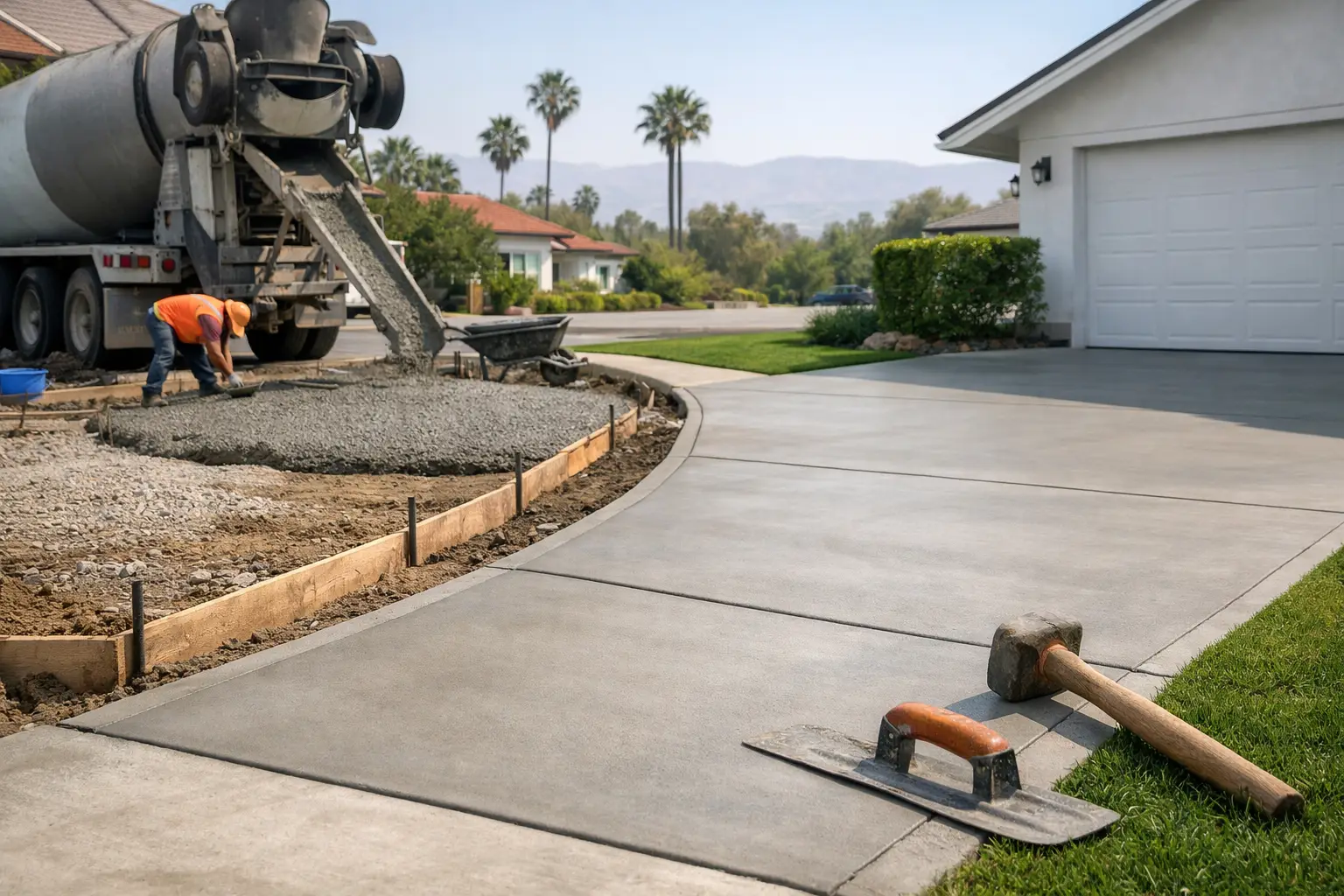
Most driveway replacements begin with demolition and site prep, followed by grading, formwork, reinforcement, and the pour itself. After placement and finishing, the slab needs time to cure before regular vehicle use. The exact timeline depends on weather, scope, inspection requirements, and whether any drainage or adjacent concrete work is part of the project.
A good contractor will explain access limitations in advance, protect nearby surfaces, and give you a realistic schedule for when the driveway can be walked on and driven on. That communication is part of the value, especially for occupied homes where daily logistics matter.
If you are planning a replacement, think beyond the initial number. The right concrete driveway replacement cost is the one that reflects proper preparation, code-aware execution, and a finished surface built to last in real-world conditions. A driveway should not just look new on completion day. It should perform well years after the trucks are gone.