Key Takeaways
- Your address decides which building department issues the permit and which zoning, hillside, or historic reviews apply.
- In the City of Los Angeles, plan check creates a list of clearances from other departments that fits your project, and each one must be signed off before the permit is issued.
- Street work, stormwater, and LADWP electric service each run on their own track, and some need a final sign-off before the job is closed.
Permit coordination for a Los Angeles remodel means lining up every agency that has to approve your project, not just the building department. Your address decides who issues the permit. Plan check decides which other departments must sign off. Some approvals, like electric service and work in the street, run on their own tracks. This Los Angeles permit coordination guide walks through those pieces in the order they usually come up, so you can plan around them before demolition starts.
What should a Los Angeles permit coordination guide help me check first?
Start by finding out which building department has authority over your address. The City of Los Angeles uses LADBS, unincorporated county areas use LA County Public Works, and every other city runs its own building department with its own rules.
A Los Angeles mailing address doesn’t mean the City of Los Angeles issues your permit. Plenty of homes with an “LA” address sit in a separate city or on unincorporated county land. LADBS, the Los Angeles Department of Building and Safety, only covers property inside City of Los Angeles limits.
To confirm, look up your parcel on the city or county online property map, or call the building department you think is in charge and give them the address. Your property tax bill can also point you in the right direction.
This matters because each department has its own intake process, its own forms, and its own local changes to the state code. A permit path that worked for a friend two cities over may not apply to you. The rest of this Los Angeles permit coordination guide focuses on the City of Los Angeles, because that’s where the multi-department clearance system has the most moving parts. Elsewhere, the questions are the same, but the agency names and steps change.
Does my remodel qualify for an Express Permit, or does it need plan check?
Simple work on the LADBS eligibility list can get an Express Permit with no plan review. Work that removes walls, adds space, or changes structure goes through counter plan check or regular plan check, where city staff review your drawings before the permit is issued.
An Express Permit is a permit LADBS issues without plan review, either online or by appointment at a Development Services Center. Plan check is the review where city staff read your drawings and send back corrections. The LADBS homeowner step-by-step guide starts with exactly this decision and points you to the official list of what qualifies. Use that list, not a rule of thumb you read somewhere.
Counter plan check handles simpler projects that still need someone to look at plans. Regular plan check is for bigger or more complex work, like an addition or a structural change. A kitchen where you take out a bearing wall isn’t an Express Permit job, even if everything else is cabinets and counters.
Plan check usually brings at least one round of corrections, so plan for it. Your plan set may also need Title 24 energy paperwork, which shows the new work meets California’s energy rules, and a plan for recycling construction debris under CALGreen, the state’s green building code. The city decides how long review takes, so don’t book crews around a guessed approval date. For kitchen details, see our post on what permits a kitchen remodel needs.
How do I find zoning, hillside, or historic flags that add reviews?
Look up your parcel on ZIMAS, the City of Los Angeles online zoning map. It shows zoning, hillside areas, fire hazard zones, historic districts, and other overlays that can add a review or limit what you can build.
ZIMAS pulls up your parcel by address. The parcel profile lists the zone, any specific plan, and flags like a Hillside Area, a Very High Fire Hazard Severity Zone, or a Historic Preservation Overlay Zone (HPOZ). An HPOZ is a neighborhood where exterior changes get design review.
Each flag can mean another set of eyes on your plans. An HPOZ may review windows and exterior changes. A hillside or fire zone can add requirements for access, materials, or grading. Planning cases already recorded on your parcel can also trigger a Planning clearance.
Print the parcel profile and hand it to your designer and contractor before anyone draws. In older Los Angeles neighborhoods, owners often find a hillside or historic flag they never knew about. It’s far easier to design around it early than to redraw after the first correction notice.
What is a clearance, and which departments might sign off before the permit is issued?
A clearance is an approval from another department that LADBS needs before it can issue your permit. Plan check generates the list, and it's specific to your project and parcel, so no single checklist fits every remodel.
LADBS publishes a Building Permit Clearance Handbook that describes the clearances that may apply. Depending on the job, they can include zoning review by City Planning, the Bureau of Engineering for street and sewer access, LA Sanitation for stormwater, and the Fire Department for hydrant and access review. Not every listed clearance applies to every project.
Treat each clearance as its own small approval with its own reviewer. One department signing off does nothing for the others. The permit waits until the last one is done.
A plain interior remodel may have few clearances or none. A remodel that adds square footage, changes a driveway, or ties into a new sewer line can pick up several. If you take one idea from this Los Angeles permit coordination guide, make it this one: find out your likely clearances while the design can still change.
When does a remodel need Bureau of Engineering permits for work in the street?
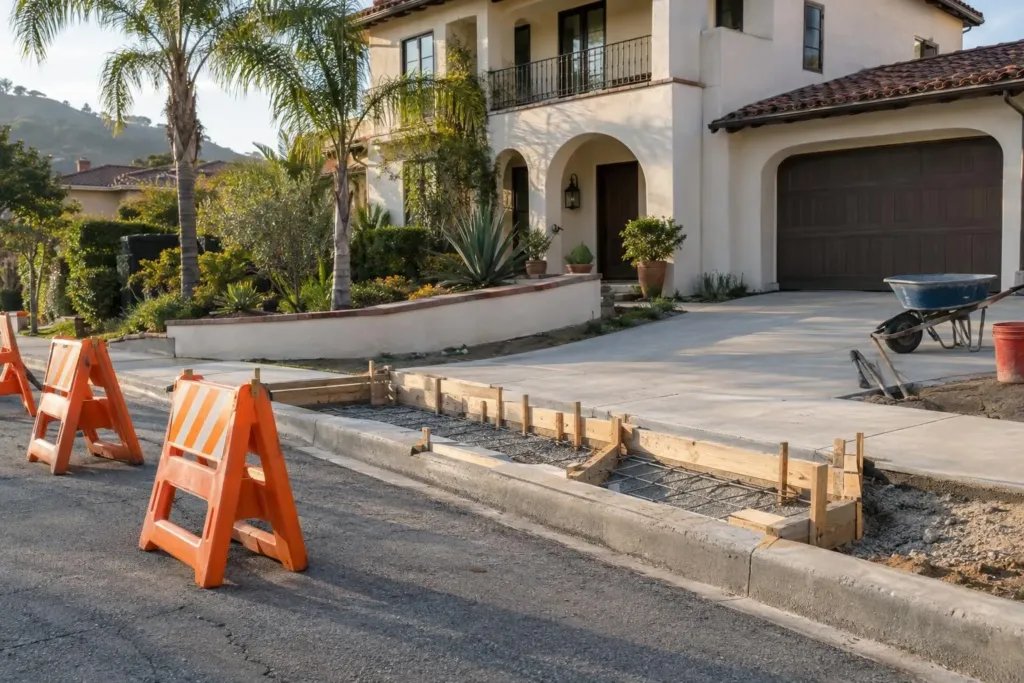
You need Bureau of Engineering review when your project touches the public right of way, which is the street, curb, sidewalk, and parkway strip the city owns. New or wider driveways, sidewalk work, and new sewer connections usually lead to separate BOE permits.
The Bureau of Engineering Permits Manual explains that BOE must review and approve plans before LADBS issues the permit when this kind of work is involved. BOE staff record their clearance in the same LADBS system, so it shows up on your permit record.
Approving street access nearly always leads to separate BOE permits, labeled by letter types like A, B, S, and R depending on the size of the work. These are different from your building permit and have their own inspections.
Watch the parkway too. If a street tree stands where a new driveway apron would go, StreetsLA Urban Forestry, the city’s street tree division, gets involved. Never cut or remove a parkway tree on your own. And if BOE required public improvements, it also has to sign off once they’re finished, before the job can be closed out.
Does my project trigger LA Sanitation's stormwater (LID) review, and is there a sign-off at the end?
LID review applies to new construction and larger expansions, not every remodel. When it applies, you need a signed LID Plan Check Clearance before the permit, plus a separate LID sign-off at the end that only LA Sanitation staff can give.
Low Impact Development, or LID, is the city’s rule that rainwater should soak into the ground on your lot instead of running into the street. LA Sanitation has separate small-scale instructions for homes with four units or fewer, and stricter criteria for sites in, near, or draining to an Environmentally Sensitive Area.
Many interior remodels never touch these rules. A project that adds a lot of new roof or paving might. Don’t assume either way. Ask your plan checker or LA Sanitation once your scope is set.
Here’s the part people miss. If your permit needed the LID Plan Check Clearance, it also needs an LID Certificate of Occupancy clearance at the end. LADBS inspectors can’t approve it. You request it from LID staff through a customer service request with photos of the drains, planters, or dry wells that were built. Take those photos before the yard is finished and the features are covered.
How do I coordinate an electrical panel or service upgrade with LADWP?
LADWP electric work runs on its own track next to your LADBS permit. Expect a meter spot visit, LADBS electrical approval, and LADWP's own inspection before the utility does its cable work and energizes the service.
In older Los Angeles homes, a kitchen or bathroom remodel often ends up needing a panel upgrade once the electrician sees how little capacity the old service has. When you install, upgrade, relocate, or modify electrical loads, equipment, or meters, LADWP expects a service request. You can start and track it through LADWP’s Power Connect online tool.
For small services, LADWP lays out its electric installation and upgrade process. A typical sequence looks like this:
- Request a meter spot, which is a site visit where LADWP confirms where the new meter panel goes.
- Pull the required LADBS electrical permit and install the equipment at that spot.
- Pass LADBS electrical inspection and get final electrical approval.
- LADWP inspects and approves the customer-installed equipment, then schedules its own cable and equipment work.
- Agree on the shutoff and reconnection date with LADWP so the house isn’t left without power longer than needed.
Upgrading an existing service usually doesn’t need a new service application. Brand-new service is different, and LADWP makes its service commitments in writing. Don’t set the panel location until the meter spot is done, because moving a meter panel after the wall is patched means doing the work twice.
Can clearances run at the same time as plan check, and who tracks them?
Some clearances can be worked on while plan check is underway, which keeps them from piling up at the end. Someone on your team should own the list, and the LADBS permit record shows where each one stands.
Once plan check generates your clearances, don’t wait for the plan checker to finish before contacting the other departments. Each reviewer works through their own queue, and the city sets the pace, not your contractor. Starting early is the part you control.
Your permit record on the LADBS site lists each clearance with its category, status, and date, and often the staff person handling it. Check it every week. When one sits untouched, call that reviewer and ask what’s missing. That’s the practical core of any Los Angeles permit coordination guide: know who’s holding each approval and keep it moving.
Decide up front who owns this job: you, your designer, or your contractor. The permit holder is also responsible for scheduling inspections and keeping the permit active once work starts, so put that role in writing. If plans change mid-job, you may need a revision and sometimes a new clearance. Our post on managing kitchen permit revisions explains how that works.
Before anyone starts, check the contractor’s license on the Contractors State License Board website and ask for proof of insurance. Our guide on how to choose a remodeling contractor covers what else to ask.
What extra rules apply to an older home or a rental with tenants?
Older homes bring asbestos, lead paint, and buried utilities into the picture, and each falls under its own agency. Rentals, especially rent-controlled units, can bring in the Housing Department if tenants must move out or a unit is removed.
Before demolition on an older house, test suspect materials like popcorn ceilings, old flooring, and pipe wrap. The South Coast Air Quality Management District (AQMD) sets the notification rules for asbestos removal, and your building permit doesn’t handle that for you. Homes built before 1978 may have lead paint, and lead-safe work rules control how it’s disturbed and cleaned up.
Any digging, even for a small footing or drain line, starts with a call to 811 through DigAlert so buried utilities get marked. Deeper excavations can fall under Cal/OSHA permit rules, so your contractor should confirm with the state before trenching gets deep.
If the property has tenants or falls under the Rent Stabilization Ordinance (RSO), check with the Los Angeles Housing Department before you start. Work that removes a unit or forces tenants to relocate can trigger its own requirements. Sort this out before you pull the permit, not after a tenant asks.
When should you bring in a licensed contractor to coordinate your permits?
Call a licensed contractor before your plans go in, not after the first correction notice. That’s especially true if your remodel moves a wall, adds space, touches the street, or needs a bigger electrical service. Villa Bella Construction is a licensed and insured general contractor that handles kitchen remodels with structural or plumbing problems and bathroom remodels that uncover rot or leaks, along with the permits that come with them. We’ll look at your address, your scope, and the existing conditions, then tell you which approvals are likely and what to do first. The city still decides approvals and timelines, but a clear plan helps you do the job once.
“immediately spotted problematic work on a project a different builder was working on” — Stephen L., Yelp review
Villa Bella Construction is a licensed and insured general contractor, building in Los Angeles for 25 years. CSLB License #1093648 (B – General Building).
Planning a construction or remodeling project in Los Angeles?
Schedule a Free On-Site Consultation or call +1 (323) 825-9798.