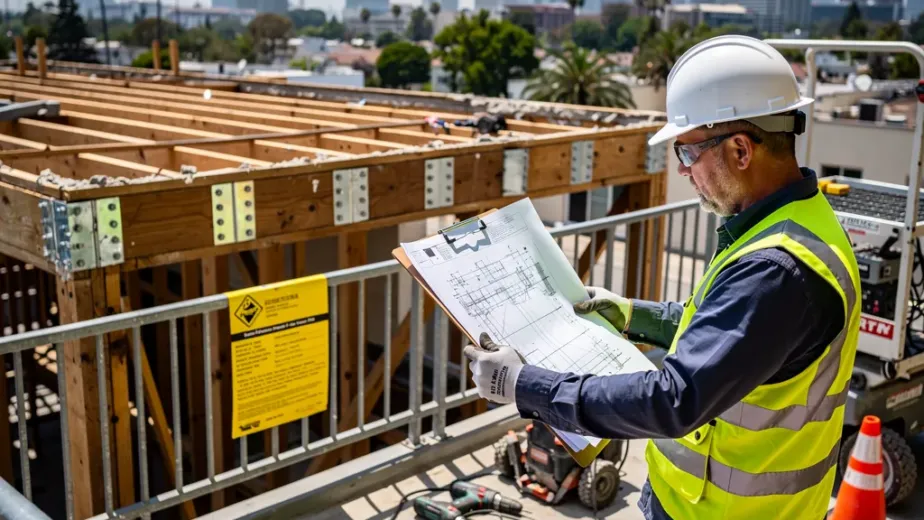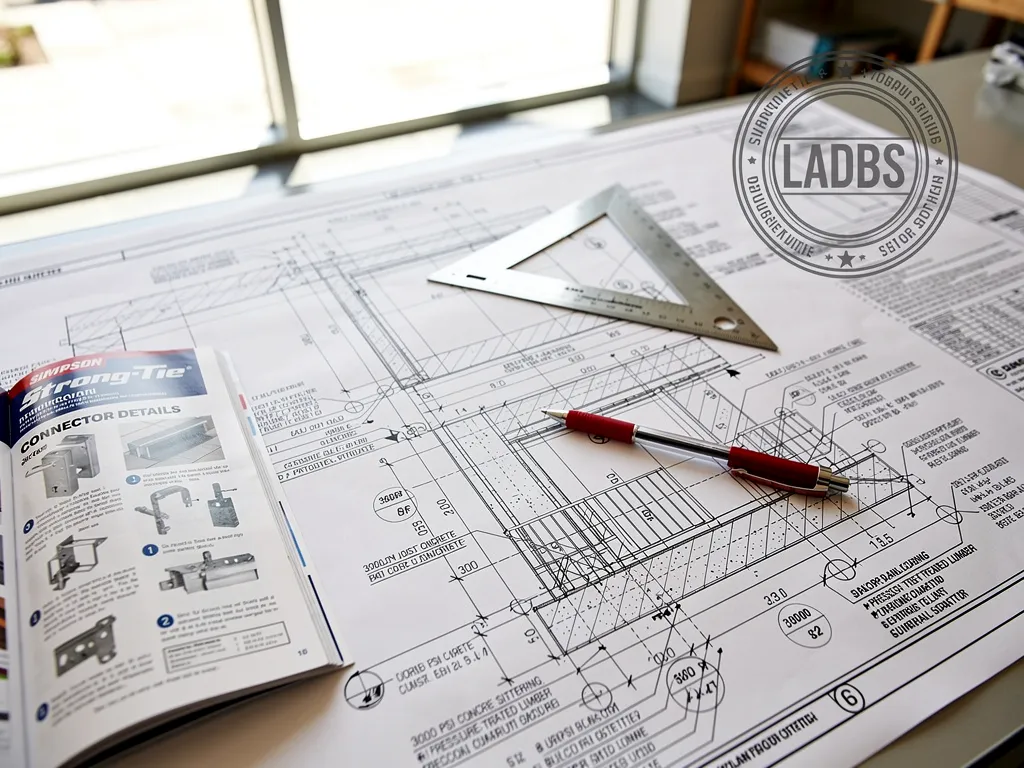
Understanding LADBS Engineering Requirements is the first step when a multi-family property in Los Angeles receives a failed SB-721 or SB-326 inspection report. The path forward requires more than cosmetic fixes; it demands structural engineering precision, LADBS-compliant plan sets, and a licensed contractor capable of executing complex repairs under the scrutiny of Los Angeles Department of Building and Safety plan checkers. Villa Bella Construction specializes in the execution phase—after the inspection is complete, we engineer, permit, and rebuild exterior elevated elements to meet current California Building Code standards
Property owners in Beverly Hills, Pasadena, and Santa Monica face a common challenge: translating an inspection report into a permittable, code-compliant repair scope. This article outlines the technical requirements, structural methodologies, and permitting workflows that define successful balcony remediation in Los Angeles.
Key Takeaways
- LADBS requires stamped structural calculations and plan sets for all balcony joist sistering and framing repairs exceeding $5,000 in valuation.
- Sistering operations must maintain or exceed original load-bearing capacity, typically designed for 60 PSF live load plus 10 PSF dead load per ASCE 7-16.
- Waterproofing integration is not optional—it must be detailed in structural drawings and inspected before final approval.
- Seismic anchorage of guardrails requires Simpson Strong-Tie or equivalent connectors with ICC-ES evaluation reports.
- Plan check timelines in Los Angeles range from 6 to 12 weeks depending on project complexity and departmental backlog.
- Successful projects require a deep understanding of all LADBS Engineering Requirements before the first joist is touched.
SB-721 Balcony Joist Sistering: A Guide to LADBS Engineering Requirements
Joist sistering is the most common structural intervention for deteriorated balcony framing. When moisture infiltration compromises the original 2×10 or 2×12 Douglas Fir joists, the repair strategy involves installing new pressure-treated lumber directly alongside the damaged member, fastened with hot-dipped galvanized or stainless steel bolts at 16-inch on-center spacing.
Material Specifications and Load Path Continuity
LADBS plan checkers require explicit callouts for lumber grade and fastener specifications to ensure the project meets all LADBS Engineering Requirements. We specify Hem-Fir No. 2 or better, pressure-treated to 0.60 PCF retention for ground contact applications. Each sistered joist must match or exceed the original member’s section modulus and moment of inertia. For a typical 12-foot cantilevered balcony carrying 60 PSF live load, a 2×10 sister paired with the existing joist provides adequate flexural strength, assuming the ledger connection is intact.
Fastener selection is non-negotiable. We use Simpson Strong-Tie SDS screws (¼-inch diameter, 3-inch length) or through-bolts with washers sized to distribute bearing stress across the wood fibers. The California Building Code references ASCE 7-16 for load combinations, and our calculations account for seismic overstrength factors in SDC D zones, which encompass all of Los Angeles County.
Ledger Board Anchorage and Shear Transfer
The ledger board is the critical load transfer point between the balcony and the primary structure. LADBS requires proof of adequate anchorage—typically ½-inch diameter lag screws or through-bolts embedded into the rim joist or band joist, spaced at 16 inches on center. When the existing ledger shows rot or splitting, full replacement is mandatory. We sister a new 2×10 ledger with Simpson LGT2Z galvanized tension ties to ensure positive connection to the floor diaphragm.
In cases where the original ledger was face-nailed—a common deficiency in pre-1980s construction—we retrofit with Simpson DTT2Z deck tension ties or equivalent, rated for 1,500-pound uplift capacity per connector. This upgrade is often flagged during LADBS plan check, and we proactively include it in our repair drawings to avoid correction cycles.
Understanding Load Paths in Los Angeles Balcony Reconstruction
Structural integrity depends on continuous load paths from the guardrail down to the foundation. LADBS plan checkers scrutinize every connection point, verifying that gravity loads, lateral seismic forces, and wind pressures are transferred without reliance on friction or inadequate fasteners.
Vertical Load Distribution
A typical 4-foot by 12-foot balcony must support a minimum of 60 PSF live load per CBC Section 1607.1. This translates to 2,880 pounds distributed across the joists. Each joist carries approximately 480 pounds if spaced at 16 inches on center. The ledger transfers this load into the building’s floor framing, which must be verified for adequate capacity. In older multi-family buildings in Pasadena, we frequently encounter undersized rim joists that require supplemental LADBS-approved reinforcement, often involving steel angle brackets or additional blocking. Calculating these loads correctly is a mandatory part of meeting LADBS Engineering Requirements for multi-family balconies.
Lateral Load Resistance and Guardrail Anchorage
Guardrail posts must resist a 200-pound concentrated load applied in any direction at the top rail, per CBC Section 1607.8.1. This requires through-bolted connections to the balcony framing, with backing plates or Simpson CPTZ post caps to prevent pullout. In seismic zones, we design for an additional 1.5x overstrength factor, bringing the effective design load to 300 pounds per post.
Guardrail posts installed directly into cantilevered joists create a torsional load that must be resolved through blocking or a continuous rim joist. We install solid 2×10 blocking between each joist bay, fastened with three 16d nails per end, to create a rigid diaphragm that distributes lateral forces. This detail is explicitly called out in our structural drawings and verified during the framing inspection.
Waterproofing Integration in SB-721 Structural Balcony Remediation
Structural repairs fail prematurely without proper waterproofing integration. Consistent with LADBS Engineering Requirements, all walking surfaces over occupied space must include a continuous waterproof membrane, sloped to drain and detailed to prevent water intrusion, sloped to drain, and detailed to prevent water intrusion at penetrations and transitions.
Membrane Selection and Application Standards
We specify hot-applied rubberized asphalt membranes or cold-applied polyurethane systems, both of which meet ASTM D6164 standards for crack-bridging and elongation. The membrane must extend 6 inches up all vertical surfaces, including walls and guardrail posts, and be terminated with a metal flashing or stucco stop to prevent water migration behind the cladding.
Slope is critical. LADBS requires a minimum 2 percent slope (¼ inch per foot) toward drainage points. On cantilevered balconies, we achieve this by tapering the plywood substrate or installing a sloped mud bed before membrane application. Flat or reverse-sloped surfaces are flagged during the rough framing inspection and must be corrected before the waterproofing trade can proceed.
Flashing and Transition Details
Every penetration—guardrail posts, downspouts, and through-wall drains—requires a detailed flashing assembly. We use 26-gauge galvanized steel or stainless steel flashing, integrated with the membrane in a shingle-lap fashion to ensure water sheds away from the structure. LADBS plan checkers require these details to be drawn in section view, showing the relationship between the membrane, flashing, and structural framing.
In Santa Monica, where coastal moisture accelerates corrosion, we upgrade to stainless steel fasteners and aluminum flashing to extend service life beyond the 20-year minimum required by warranty standards.
Seismic Retrofitting and Guardrail Anchorage for LA Balconies
Los Angeles sits in Seismic Design Category D, which imposes stringent anchorage and bracing requirements. Guardrail systems must be designed as non-structural components per ASCE 7-16 Section 13.3, with anchorage forces calculated using the component amplification factor and seismic response coefficient.
Post-to-Deck Connection Engineering
We design guardrail post connections to resist a base shear of 0.4 times the component weight, multiplied by the seismic importance factor. For a 40-pound guardrail post, this results in a 16-pound lateral force—but when combined with the 200-pound live load requirement, the governing load case is always the live load. However, the connection must be detailed to prevent brittle failure modes, which means through-bolted connections with steel backing plates are mandatory.
Simpson CPTZ post caps, rated for 1,500-pound uplift and 1,000-pound lateral capacity, are our standard specification. These connectors are ICC-ES evaluated and pre-approved by LADBS, which accelerates plan check. We avoid proprietary or non-evaluated hardware, as these trigger additional scrutiny and delay permit issuance.
Anchorage to Masonry and Concrete Substrates
When guardrails anchor to concrete or CMU Block Walls, we use Hilti Kwik Bolt TZ or Simpson Titen HD anchors, installed per ICC-ES evaluation reports. Minimum embedment depth is 3 inches into 3,000 PSI concrete, with edge distances and spacing per the manufacturer’s published tables. LADBS inspectors verify anchor installation with torque wrenches during the framing inspection, and any anchor that fails to achieve the specified torque must be replaced and re-inspected.
In cases where the existing concrete is spalled or lower than 2,500 PSI—common in 1960s-era construction in Beverly Hills—we specify epoxy-grouted anchors or chemical adhesive systems that develop full capacity in degraded substrates. These upgrades add cost but are non-negotiable for code compliance. Using the correct Hilti or Simpson anchors ensures the connection satisfies stringent LADBS Engineering Requirements.
Navigating LADBS Plan Check for Multi-Family Structural Repairs
LADBS plan check is a multi-stage process that begins with submittal of a complete plan set, including architectural, structural, and waterproofing details. For balcony repairs exceeding $5,000 in valuation, a California-licensed structural engineer must stamp the drawings and calculations.
Plan Set Requirements and Submittal Protocols
A compliant plan set includes a cover sheet with project address and scope narrative, a site plan showing the location of affected balconies, structural framing plans with member sizes and connection details, and section cuts through critical assemblies. LADBS requires that all drawings be submitted electronically through the Los Angeles Building and Safety online portal, with PDF files sized for 24×36-inch sheets.
Plan check timelines vary. For projects classified as Standard Plan Check, expect 6 to 8 weeks for the first review cycle. Complex projects involving multiple buildings or non-standard details may be routed to Discretionary Plan Check, which extends timelines to 10 to 12 weeks. We proactively engage with LADBS plan checkers during the pre-submittal phase to identify potential issues and streamline the review process.
Correction Cycles and Resubmittal Strategy
Most projects receive correction requests after the first review. Common issues include missing connection details, inadequate fastener specifications, and incomplete waterproofing transitions. We address corrections within 48 hours and resubmit electronically, which resets the clock for a secondary review—typically 3 to 4 weeks.
To minimize correction cycles, we cross-reference our drawings against LADBS Information Bulletins and the California Residential Code Chapter 5. We also include prescriptive details from the American Wood Council’s DCA6 guide, ensuring our plans align with pre-approved LADBS Engineering Requirements to minimize delays.
Field Note: Pasadena Multi-Family Balcony Reconstruction
In 2023, Villa Bella Construction completed a 16-unit apartment complex repair in Pasadena following a failed SB-721 inspection that identified advanced dry rot in 12 cantilevered balconies. The original construction, dating to 1972, used untreated Douglas Fir joists with face-nailed ledger boards—a configuration that failed to meet current CBC standards.
Our engineering team designed a full joist replacement strategy, specifying pressure-treated 2×10 joists sistered to the remaining sound framing. The ledger board required complete replacement, anchored with ½-inch through-bolts at 12 inches on center, embedded into the existing floor diaphragm. Guardrail posts were upgraded with Simpson CPTZ post caps, and all connections were detailed to resist the 200-pound concentrated load requirement.
Waterproofing integration presented a unique challenge: the existing concrete deck had a reverse slope, ponding water against the building façade. We removed the deteriorated concrete, reframed with a 2 percent slope toward the exterior, and applied a hot-rubberized asphalt membrane with stainless steel flashing at all penetrations. LADBS conducted three inspections—rough framing, waterproofing, and final—all of which passed without correction.
The project required 8 weeks for plan check and 6 weeks for construction, with a total investment of $180,000. The property owner received a 10-year warranty on all structural and waterproofing work, and the building was recertified for SB-721 compliance.
Integration with Foundation Engineering and Structural Systems
Balcony repairs do not exist in isolation. Load paths extend down through the building’s floor framing and into the Foundation Engineering system. In cases where balcony loads exceed the capacity of the existing foundation, supplemental footings or grade beams may be required—a scope that LADBS will flag during plan check.
We coordinate with geotechnical engineers to verify soil-bearing capacity, typically 1,500 PSF for native Los Angeles Basin soils. When soils are expansive or unstable, we design deeper footings with reinforced concrete and doweled connections to the existing foundation. These interventions add complexity and cost, but they are essential for long-term structural stability.
Frequently Asked Questions
What is the typical timeline for LADBS plan check and permit issuance for balcony repairs?
Standard plan check takes 6 to 8 weeks for the first review cycle. After addressing corrections, resubmittal review adds 3 to 4 weeks. Total timeline from submittal to permit issuance averages 10 to 12 weeks, assuming no major design issues are identified.
Do I need a structural engineer for balcony joist sistering in Los Angeles?
Yes. LADBS requires stamped structural drawings and calculations for any repair exceeding $5,000 in valuation or involving load-bearing modifications. A California-licensed structural engineer must review the existing conditions, design the repair, and seal the plan set.
Can Villa Bella Construction handle both the engineering and the construction for my SB-721 repairs?
Yes. We manage the entire repair process, including coordination with our network of California-licensed structural engineers, LADBS plan submittal, permit acquisition, construction, and final inspection. We do not perform the initial SB-721 inspection—we execute the repairs after you receive the inspection report.
Property owners in Los Angeles face a complex regulatory and technical landscape when addressing failed SB-721 or SB-326 inspections. Success requires a licensed contractor with deep experience in LADBS permitting, structural engineering integration, and field execution. Villa Bella Construction brings 25 years of expertise to every project, ensuring that your balcony repairs meet code, pass inspection, and protect your investment for decades. Contact us today for a free estimate and detailed scope review tailored to your property’s specific conditions.