When structural deterioration compromises elevated exterior elements in multi-family residential properties across Los Angeles, property owners face a complex intersection of state-mandated compliance and municipal permitting requirements. Senate Bill 721 establishes inspection protocols for exterior elevated elements, but the subsequent repair phase demands rigorous adherence to Los Angeles Department of Building and Safety (LADBS) permitting procedures. For licensed general contractors executing structural remediation—not conducting initial inspections—understanding the technical specifications, plan check requirements, and approval timelines becomes critical to project success.
Key Takeaways: LADBS Permitting for SB-721 Structural Repairs
- LADBS requires structural calculations stamped by a California-licensed structural engineer for all load-bearing repairs exceeding 100 square feet or involving primary framing members
- Standard plan check duration ranges from 6 to 12 weeks depending on project complexity and current departmental backlog
- Permit valuation must include material costs, labor, equipment rental, and engineering fees with minimum thresholds of $500 for minor repairs
- Field inspections occur at three mandatory stages: post-demolition, framing/structural, and final
- Contractors must maintain active California Contractor’s License (B or C-5 classification) with minimum $1,000,000 general liability coverage
Regulatory Framework: SB-721 Compliance and Municipal Authority
Senate Bill 721, codified in California Civil Code Section 1954.605, mandates visual inspections of exterior elevated elements in multi-family residential buildings containing three or more dwelling units. These inspections must occur every six years, with initial deadlines established by January 1, 2025, for most jurisdictions. However, the legislation addresses only the inspection requirement—the actual structural remediation falls under local building department jurisdiction.
In Los Angeles, the Department of Building and Safety exercises authority over all structural modifications through Chapter IX of the Los Angeles Municipal Code. This creates a dual-compliance scenario: property owners must satisfy state inspection mandates while contractors executing repairs must navigate LADBS permitting protocols. The Los Angeles Department of Building and Safety processes approximately 85,000 building permits annually, with structural repair applications representing 12-15% of total volume.
Pre-Application Requirements for Structural Repair Permits
Before submitting permit applications to LADBS, contractors must compile comprehensive documentation establishing project scope, structural methodology, and compliance with current California Building Code (CBC) standards. The 2022 CBC, based on the International Building Code with California amendments, governs all structural modifications in Los Angeles.
Engineering Documentation and Structural Calculations
All repairs affecting load-bearing components require structural calculations prepared and stamped by a California-licensed structural engineer (S.E. or P.E. with structural emphasis). These calculations must demonstrate that repaired elements will support dead loads, live loads of 60 pounds per square foot for residential balconies, and lateral forces per ASCE 7-16 wind load provisions. For Los Angeles County, design wind speeds range from 85 to 110 miles per hour depending on exposure category and terrain roughness.
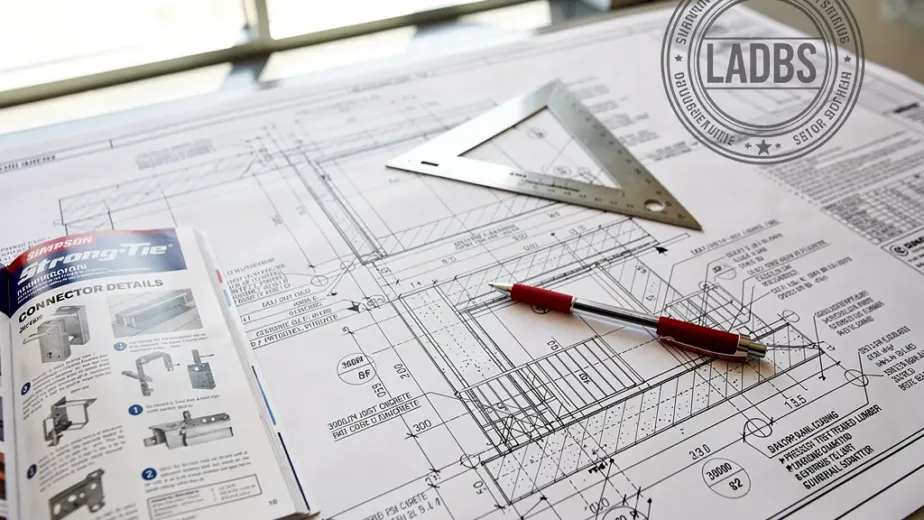
Structural drawings must include plan views, elevation details, section cuts showing existing and proposed framing, connection details with specified fastener types (typically Simpson Strong-Tie or equivalent connectors), and material specifications. Lumber grades must meet minimum standards of Douglas Fir-Larch No. 2 or better, with pressure-treated material for all elements within 18 inches of grade or exposed to weather. Steel reinforcement requires Grade 60 rebar with minimum concrete compressive strength of 2,500 PSI at 28 days for footings and 3,000 PSI for elevated slabs.
Title 24 Energy Compliance and Accessibility
While balcony repairs primarily address structural deficiencies, projects triggering alterations exceeding $165,000 in valuation may invoke Title 24 energy compliance requirements. Additionally, repairs affecting means of egress or accessibility pathways must comply with California Building Code Chapter 11B accessibility standards, including maximum slope ratios of 1:12 for ramps and minimum clear width of 36 inches for circulation paths.
LADBS Application Submission and Plan Check Process
Los Angeles Department of Building and Safety operates both physical plan check centers and the online PCIS (Plan Check and Inspection System) portal. For structural repairs in areas including Beverly Hills, Santa Monica, Glendale, Pasadena, Culver City, and Highland Park, contractors typically submit applications through the Metro Regional Office or Van Nuys District Office depending on project location.
Required Submittal Documents
Complete permit applications require three sets of structural drawings (24-inch by 36-inch format), engineering calculations, soils reports if foundation work exceeds 18 inches in depth, contractor’s license verification, workers’ compensation certificate, and permit application form PCAF-001. Permit valuation must reflect total project cost including materials, labor, equipment, and professional fees. LADBS applies a fee schedule based on valuation, with typical structural repair permits ranging from $800 to $4,500 depending on scope.
Plan Check Timeline and Correction Cycles
Initial plan check duration averages 8 to 10 weeks for standard structural repairs, though complex projects involving multiple structural systems may extend to 14 weeks. Plan checkers review submissions for code compliance, structural adequacy, and completeness. Correction notices typically identify deficiencies requiring resubmittal, with each correction cycle adding 3 to 4 weeks to approval timeline. Expedited plan check services reduce review time to 10 business days but increase fees by 100% of base permit cost.
Field Inspection Protocols and Approval Stages
Once LADBS issues permits, contractors must schedule mandatory inspections at prescribed construction milestones. Inspection requests require 24-hour advance notice through the LADBS automated system, with inspectors typically arriving within a 4-hour window on scheduled dates.
Post-Demolition and Framing Inspections
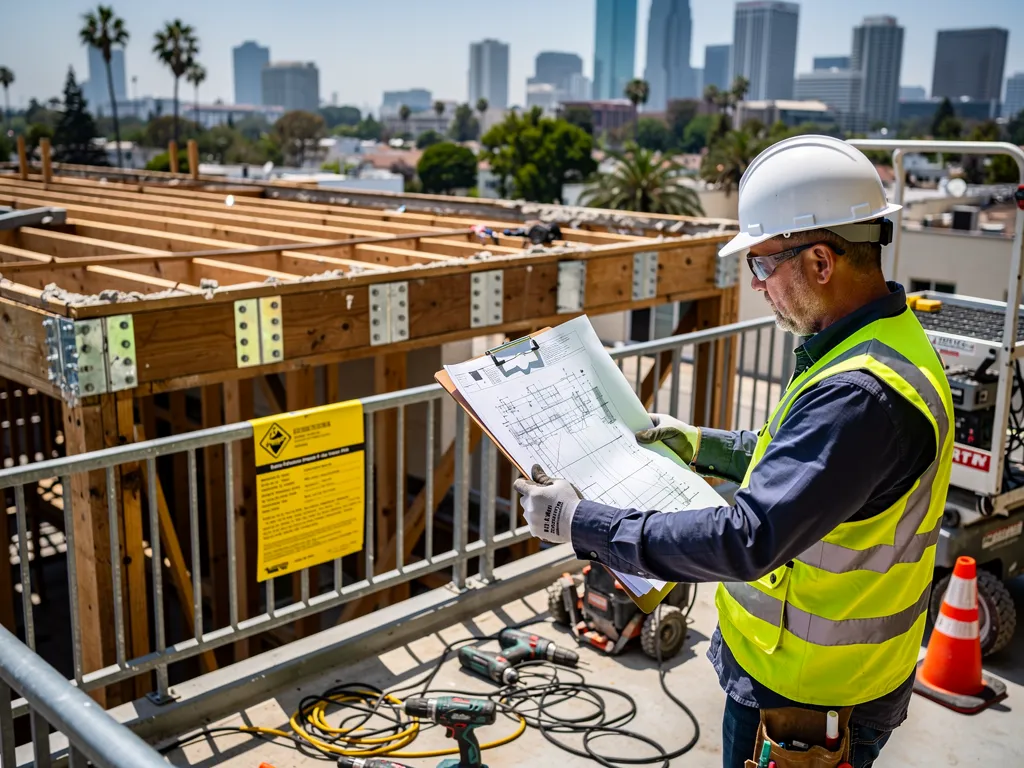
The first critical inspection occurs after demolition of deteriorated elements but before installation of new framing. Inspectors verify existing conditions match engineering assumptions, assess substrate integrity, and confirm proper removal of compromised materials. Framing inspections follow installation of structural members but precede application of sheathing or finish materials. Inspectors verify lumber grades, fastener spacing (typically 16 inches on-center for joists, 24 inches for blocking), connection hardware installation, and flashing details at building interfaces.
Final Inspection and Certificate of Occupancy
Final inspections encompass completed work including waterproofing membranes, drainage systems, guardrail installations meeting 42-inch minimum height requirements, and finish materials. Inspectors verify guardrail strength through field testing, confirm proper slope for drainage (minimum 1/4 inch per foot), and review waterproofing continuity. Upon approval, LADBS issues a Certificate of Completion, formally closing the permit and establishing code compliance for liability purposes.
Field Note: Complex Balcony Reconstruction in Pasadena
In March 2023, Villa Bella Construction executed a comprehensive structural repair at a 1978-vintage apartment complex in Pasadena following an SB-721 inspection that identified advanced dry rot in cantilevered balcony joists. The project involved 14 balconies across three buildings, with structural failures extending into primary floor framing. Our engineering partner calculated that 6 of the 14 balconies had lost 40% of load-bearing capacity due to fungal decay and inadequate flashing at ledger board connections.
We submitted permit applications to LADBS Pasadena District Office in April 2023, including structural calculations for sistered 2×10 Douglas Fir joists, Simpson HTT5 tension tie installations at 8 locations, and complete waterproofing system redesign incorporating Schluter-KERDI membrane with integrated drainage mat. Initial plan check identified deficiencies in our shear transfer calculations at the building interface, requiring revision of Simpson Strong-Tie connector specifications from HTT4 to HTT5 models to achieve 3,200-pound uplift resistance. The correction cycle added 4 weeks to our timeline, with final permit issuance occurring in late June 2023.
During demolition inspection, the LADBS inspector identified additional concealed damage in rim joists not visible during initial assessment, requiring field modification of our structural approach. We coordinated with our structural engineer to issue revised calculations within 72 hours, demonstrating that proposed repairs would maintain structural integrity despite expanded scope. The project required four separate inspections: post-demolition, framing, waterproofing, and final. Total permit duration from application to Certificate of Completion spanned 18 weeks, with construction phase consuming 9 weeks across staggered building access schedules to minimize tenant disruption.
Common Permit Deficiencies and Avoidance Strategies
Analysis of LADBS correction notices for Los Angeles balcony repair permits reveals recurring deficiencies that extend approval timelines. The most frequent issues include incomplete structural calculations missing load path analysis, inadequate connection details at cantilever supports, missing flashing and waterproofing specifications, and insufficient guardrail anchorage calculations.
Structural Calculation Completeness
Plan checkers consistently reject calculations that fail to demonstrate complete load paths from applied loads through structural members to foundation elements. Engineers must explicitly show tributary areas, load combinations per ASCE 7-16 Section 2.3, member capacity calculations using allowable stress design or load and resistance factor design methodologies, and deflection analysis confirming maximum spans do not exceed L/240 under live load for balconies.
Waterproofing System Integration
LADBS requires detailed waterproofing specifications including membrane type, manufacturer’s installation instructions, drainage provisions, and termination details at building penetrations. Successful applications reference specific products (e.g., Duradek vinyl membrane system, Tremco Vulkem 116 sealant) with technical data sheets attached. The California Building Standards Commission publishes interpretive guidelines addressing waterproofing requirements under CBC Chapter 14.
Post-Permit Considerations and Long-Term Compliance
Securing LADBS permit approval represents the authorization phase, but contractors must maintain compliance throughout construction and documentation phases. Permit cards must remain posted at job sites, with permit numbers visible from public right-of-way. Any deviations from approved plans require formal change orders submitted through LADBS correction process, with associated plan check fees and review timelines.
Upon project completion, contractors should provide property owners with complete permit documentation including approved plans, engineering calculations, inspection records, and Certificate of Completion. This documentation establishes code compliance for future property transactions, insurance claims, and subsequent SB-721 inspection cycles. Property owners must retain these records for minimum 10 years per California Business and Professions Code Section 7110.
Frequently Asked Questions
What is the typical cost range for LADBS permits on SB-721 balcony repairs?
Permit costs vary based on project valuation, but typical structural balcony repairs range from $1,200 to $5,800 in permit fees alone. This includes plan check fees (65% of permit fee), permit issuance (35%), and any required special inspection fees. Projects valued above $50,000 may require additional LADBS-approved special inspection agencies for structural welding or concrete placement, adding $800 to $2,400 in inspection costs. Expedited review increases fees by 100% but reduces plan check time from 8-10 weeks to 10 business days.
Can property owners pull permits themselves, or must a licensed contractor submit applications?
California law allows property owners to pull permits for work on their own single-family residences, but SB-721 applies to multi-family properties containing three or more units. For these properties, LADBS requires permit applications from licensed contractors holding active B (General Building) or C-5 (Framing and Rough Carpentry) classification. The contractor’s license number must appear on all submitted documents, and the contractor assumes legal responsibility for code compliance. Owner-builder permits are not applicable for structural repairs in multi-family residential buildings in Los Angeles.
How long do approved permits remain valid before expiration?
LADBS issues permits with 180-day validity from issuance date. Contractors must commence work and pass at least one inspection within this period to maintain permit active status. If no inspections occur within 180 days, permits expire and require renewal applications with associated fees (50% of original permit cost). Projects experiencing delays can request permit extensions before expiration by submitting written justification and paying extension fees. Each extension grants an additional 180 days, with maximum three extensions allowed before requiring complete reapplication.
For property owners and managers facing SB-721-mandated structural repairs across Greater Los Angeles, partnering with experienced contractors who understand LADBS permitting complexities ensures regulatory compliance and structural integrity. Villa Bella Construction brings 25 years of expertise managing complex structural repairs from initial engineering coordination through final inspection approval. Our team handles complete permit processing, plan check coordination, and city inspection scheduling, allowing property owners to focus on tenant relations rather than bureaucratic navigation. Contact Villa Bella Construction today for a comprehensive evaluation and free estimate on your balcony structural repair project. Our licensed professionals serve Beverly Hills, Santa Monica, Glendale, Pasadena, Culver City, Highland Park, and surrounding Los Angeles communities with proven expertise in municipal permitting and structural remediation.