Key Takeaways
- Most balcony leaks start where the waterproofing layer under the surface fails or isn't sealed to the drain, door, walls, or railing posts.
- A stain on the ceiling below can mean hidden rot in the balcony framing, so safety comes before drywall.
- In apartments and condos, the owner or HOA usually handles the repair, and rebuilding the waterproofing needs a permit and city inspections.
A balcony leaking into unit below almost always means water is getting past the waterproofing layer under the tile or coating. It can also slip in at an edge: the drain, the door threshold, the wall flashing, or the railing posts. The stain on the ceiling only shows where the water finally came out. The real job is to find where it gets in, check the wood framing it has been soaking, and rebuild the waterproofing correctly with a permit.
What causes a balcony leaking into unit below, sometimes far from the balcony?
Water gets through a failed or poorly connected waterproofing layer, then runs along the plywood and joists until it finds a low spot or a gap in the ceiling. That's why the stain can appear several feet away from where the water actually gets in.
A wood-framed balcony is really a floor that sits outdoors. The tile, concrete topping, or coating you walk on isn’t what keeps the water out. Underneath is a membrane: a continuous waterproof sheet or liquid-applied layer that’s supposed to carry every drop to the drain or off the edge. When that layer tears, wears out, or was never sealed at the edges, water reaches the plywood.
From there, the water follows gravity and the framing. It runs along the top of a joist, drips off a nail, soaks through the plywood, and lands on the drywall wherever it can. In older Los Angeles apartment buildings, balcony joists often run straight into the building, so water can travel inside the floor to a ceiling that seems unrelated.
Timing gives you clues. A leak that shows up hours after the rain stops, or keeps dripping the next day, usually means water is pooling inside the balcony. A leak that only appears when someone hoses off the balcony often points to the surface or the drain.
Is the leak coming from the membrane, the drain, the door threshold, the wall flashing, or the railing posts?
It can be any of them, and sometimes more than one at once. The membrane and the spots where it meets the drain, door, and walls are the usual suspects, with railing post holes close behind.
- The membrane. Old sheet membranes, thin plastic layers, and worn coatings crack or tear with age. Tile and grout aren’t waterproof, so water soaks through them and sits on whatever is below.
- The drain or scupper. A scupper is the opening at the balcony edge that lets water spill off. If the membrane isn’t sealed into it, water runs under the drain instead of through it.
- The door threshold. The threshold is the strip at the bottom of the balcony door. If the balcony surface was built up over the years, water can sit against it and run under the frame into the floor.
- The wall flashing. Flashing is a metal or membrane strip that turns up the wall so water can’t get behind the stucco where the floor meets it. When it’s missing or too short, water slips behind the wall.
- Railing posts. Every post or bolt that goes through the surface is a hole in the waterproofing.
Walk the balcony and look for warning signs. Watch for cracks along the wall line, a surface that slopes toward the door instead of away from it, puddles that stay after rain, tile that sounds hollow when you tap it, and rust streaks running down from the post bases.
Below the balcony, look at the underside if you can see it. The soffit is the finished ceiling under the balcony. Peeling paint, bubbling stucco, and dark stains on the soffit tell you water is already getting into the framing.
How do I confirm the balcony is the source before paying for demolition?
Rule out the door, nearby windows, the stucco wall, and any plumbing first, then test the balcony one area at a time. A careful water test and moisture readings tell you much more than a guess does.
Plenty of leaks that look like balcony leaks turn out to be something else. A sliding door with no pan under its sill, a window above that only leaks in hard storms (we cover that in our post on window leaks during heavy rain), cracked stucco, or a supply line inside the wall can all stain the same ceiling.
- Write down when the leak shows up: during any rain, only in wind-driven storms, or also when someone waters plants or washes the balcony.
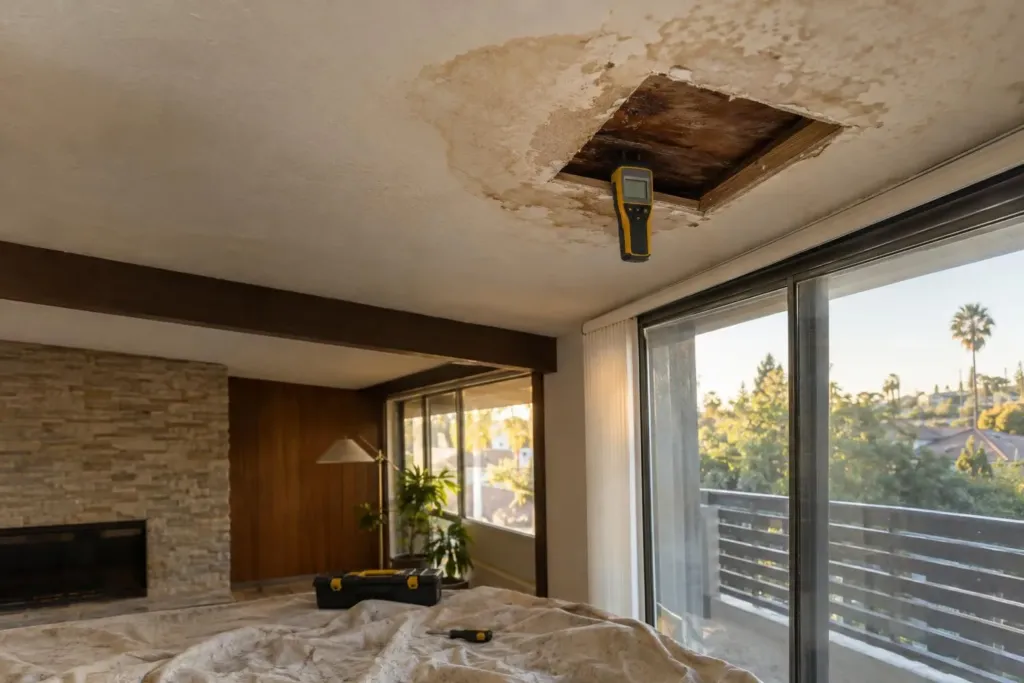
- Check the ceiling below with a moisture meter and mark the edges of the wet area.
- Water-test one area at a time, starting with the open floor of the balcony, then the drain, then the door threshold, then the wall line and the posts. Give each area time before you move on.
- If the testing points to the balcony, open a small inspection hole in the ceiling below to see the plywood and joists before anyone touches the tile.
Testing one spot at a time is the whole point. Spray everything at once and all you learn is that the building leaks, which you already knew.
Opening the ceiling below is usually less messy than tearing up tile on a hunch, and it shows you the condition of the wood. If you’ve had a balcony leaking into unit below for more than one rainy season, it deserves that look.
Can a coating or sealant fix the leak, or does the tile have to come off?
Caulk or a coating over the tile can slow a leak, but it rarely fixes a failed membrane underneath. If the wood below is wet or soft, the surface has to come off so the framing can be repaired and the waterproofing rebuilt.
Sealing grout or rolling a clear coating over old tile treats the top layer, but the water was never supposed to stop there. Worse, a surface coating can trap water that’s already inside, so the wood stays wet longer. A real coating system goes on over a clean, sound wood deck, not over failed tile.
Not every leak calls for a full rebuild. If the problem is a single bad detail, like a drain that was never sealed or a short piece of flashing at the door, a targeted repair at that spot can work. You can’t know which one you have until someone sees the wood under it.
Here’s what a full rebuild looked like on one job Villa Bella Construction handled in 2025. We got a night call during a rainstorm: water was falling into the unit below. The second-floor balcony was concrete laid over plywood with a thin plastic layer between them, and that layer had torn. The plywood was rotten, and the wood-and-stucco railing had dry rot and was loose. We removed the balcony floor, replaced the plywood and the rail framing, and installed a multi-coat waterproofing system made for wood decks. We ran the flashing about six inches up the wall so water couldn’t get behind the stucco, and no leak has been reported since.
Does a leaking balcony mean the wood framing is rotting, and is it safe to use?
Not always. But wood that stays wet long enough will rot, and you can't see it from the top of the balcony. Until a qualified person looks at the framing, treat the leak as a possible safety problem, not just a ceiling stain.
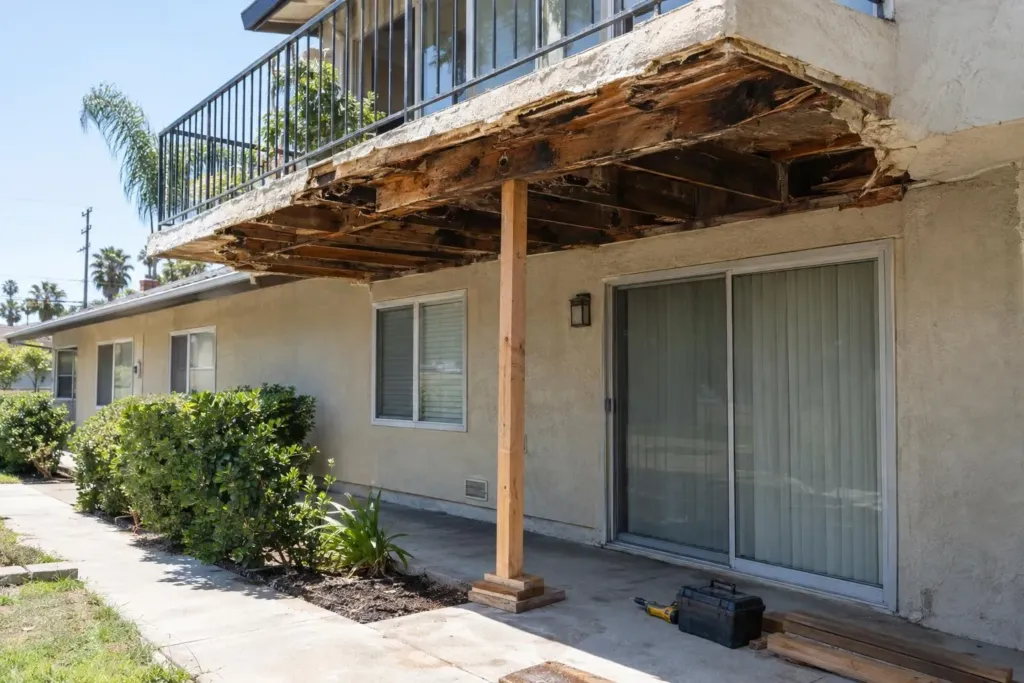
Dry rot is a fungus that eats wet wood until it turns soft and crumbly. In older Los Angeles buildings, rot often hides under the balcony membrane where water collects. It also forms at the ends of the joists where they enter the wall, and that’s exactly where the balcony gets its support.
Warning signs include a floor that feels soft or bouncy, an outer edge that sags, a railing that moves when you lean on it, cracked or bulging stucco underneath, rusted metal connectors, and a musty smell in the unit below. Any one of these is reason to stop using the balcony until it’s checked.
In the meantime, keep people off, and move heavy planters, grills, and furniture off the balcony. The drywall below is the easy part to fix. The wood holding up the balcony is what matters.
Who pays for the repair: me, the owner upstairs, the landlord, or the HOA?
It depends on the type of building and who is responsible for maintaining the balcony. In an apartment building, that's the building owner. In a condo, the HOA usually handles balconies it maintains, but your governing documents decide.
For apartment buildings with three or more units, SB-721, the state law on exterior elevated elements, puts repairs and ongoing maintenance on the building owner. A tenant upstairs isn’t the one paying to rebuild the balcony.
Condos are less simple. A balcony can be common area that only one owner uses, and the CC&Rs spell out who repairs the waterproofing and who repairs the framing. CC&Rs are the HOA’s governing rules. Read them before anyone agrees to pay.
Insurance is its own question. The HOA’s master policy, the upstairs owner’s policy, and your own policy may each cover part of the damage, or none of it. Read the actual policy wording and talk to your agent before you assume anything. The cost of fixing the balcony and the cost of the damage inside your unit can land on different people.
Does SB-721 or SB-326 apply to my building's balcony?
If the building has three or more units and the balcony is supported mainly by wood, one of these laws likely applies: SB-721 for apartments and SB-326 for condos. Both laws cover the waterproofing, not just the structure.
The SB-721 statute on the California Legislature’s site requires apartment owners to have a sample of at least 15 percent of each type of balcony, deck, and similar element inspected, with the first inspection due by January 1, 2026, and then every six years. A later amendment, AB 2579, spells out that flashings, membranes, coatings, and sealants are part of what gets inspected. A leak is exactly what those inspections are meant to catch.
SB-326 covers condos. The association board must have periodic visual inspections of the balconies it maintains, covering both the load-bearing parts and their waterproofing. Neither law applies to single-family homes, duplexes, or balconies built entirely of concrete or steel.
If an inspector finds an immediate danger, AB 2579 treats it as an emergency, and the owner has to take protective steps right away. That can mean blocking access to the balcony or putting in shoring, which means temporary posts and beams that hold the balcony up until it’s repaired.
The apartment balcony inspection article of state law lists who may do apartment inspections, including licensed architects, civil or structural engineers, and contractors with certain license classes. It also requires apartment owners to keep reports for at least two inspection cycles and give them to the buyer when the building is sold. Condo inspections have stricter rules. A separate licensed inspector or engineer does the official inspection, and Villa Bella Construction does the repair work afterward. Our guide to balcony inspection reports explains how to read the findings.
Do I need an LADBS permit and inspections to rebuild balcony waterproofing?
In the City of Los Angeles, replacing balcony framing or rebuilding its waterproofing generally needs a building permit and LADBS inspections. LADBS covers only the City of Los Angeles; other cities have their own building departments. Each department decides approvals and timelines.
LADBS has written guidance on exterior elevated elements covering how balconies and their waterproofing must be built and inspected. The key point for you: the waterproofing gets inspected as its own step before it’s covered up. If tile goes down before that inspection, it may have to come back up.
- Get a clear picture of the damage from the opened ceiling, the inspection report, or both.
- Bring in an engineer if the framing needs a structural design.
- Apply for the permit and answer any plan review comments.
- Remove the damaged surface and wood, then repair the framing and pass the framing inspection.
- Install the membrane, drain connection, and flashing, then pass the waterproofing inspection before covering it.
- Finish the surface and railing and get the final inspection signed off.
How long this takes depends on what’s found under the surface and on the city’s review and inspection schedule, so plan around the building department’s timing, not a fixed date. Our post on the LADBS permit process for balcony repairs goes deeper.
The unit below usually needs its own repair once the source is fixed: wet drywall cut out, the framing dried, any mold handled, and the ceiling patched and painted. Don’t close that ceiling until the balcony above has been fixed and tested. Our balcony and exterior stair repair work covers the full job.
I have water coming through my ceiling. Who do I tell, and what should I record?
Tell whoever controls the balcony in writing, right away. That's your landlord or property manager if you rent, or the HOA and the upstairs owner if you own a condo. Photograph everything and keep a dated record before anything gets cleaned up.
- Photos and video of the stain, any dripping, and the balcony surface above, taken during or right after rain.
- The date, the time, and the weather each time it leaks.
- Damaged belongings, flooring, and furniture before you move or throw anything away.
- Copies of every email, text, and letter about the leak.
Renters in the City of Los Angeles can find balcony rules for apartment buildings on the Los Angeles Housing Department’s exterior elevated elements page. LAHD also warns that some private companies send balcony-inspection notices that look like government letters. Check who sent a notice before acting on it.
Owners should keep every inspection report, permit, and repair record in one file. A clean file helps when a balcony leaking into unit below turns into an insurance claim or a dispute with a neighbor, and it makes the next inspection simpler.
When should you call a licensed contractor about a leaking balcony?
Call a licensed and insured contractor once you’ve confirmed the balcony is the source, or as soon as you see soft wood, a loose railing, sagging, or a leak that keeps coming back after patches. If a balcony inspection report lists repairs, bring a contractor in after the inspector so the fix matches what the report found and what the city will accept.
A good contractor finds the real entry point before tearing anything out. They repair only what the damage requires and build the waterproofing so it’s ready for its inspection before being covered. They’ll also tell you plainly when the problem is bigger than a patch.
“Steve was easy to work with and was very responsive.” — Bill M., Yelp review
Villa Bella Construction is a licensed and insured general contractor, building in Los Angeles for 25 years. CSLB License #1093648 (B – General Building).
Planning a construction or remodeling project in Los Angeles?
Schedule a Free On-Site Consultation or call +1 (323) 825-9798.