Key Takeaways
- State law generally bars the city from requiring a new sewer lateral or new utility connection for an ADU built inside an existing garage.
- The drain lines and wiring on your own lot still have to meet code, and every City of Los Angeles ADU needs a sewer availability clearance.
- A load calculation decides whether you need a panel or service upgrade. No blanket rule requires one, and a separate meter is optional.
Usually no. The City of Los Angeles generally can’t force a garage-to-ADU conversion to add a new sewer line to the street or a new electrical service. The ADU sewer and electrical work on your own property still has to pass code, though. That includes the drain line from the garage to your house sewer, the wiring to the unit, and sometimes the main panel. The confusion comes from mixing two separate questions. The first is whether the law requires a new utility connection. The second is whether the work on your lot is enough to pass inspection. This article takes them one at a time, so you can plan your ADU and garage conversion with fewer surprises.
Does ADU sewer and electrical work mean a new connection to the street?
Not as a legal requirement. California's ADU law says a local agency can't require a new or separate utility connection for an ADU built inside an existing accessory structure like a garage. You will still have sewer and electrical work, but it usually stays on your side of the property line.
A sewer lateral is the private pipe that carries waste from your property out to the public sewer in the street. A service drop is the power line or underground feed that brings electricity from the utility to your meter. State law protects you from being forced to add either of these connections. The California Department of Housing and Community Development (HCD) ADU technical assistance memo explains how that rule applies to ADUs built inside existing space.
Some online pages take that too far and claim a conversion never needs any sewer work. That’s wrong. The garage has to drain somewhere, and the new line has to meet the plumbing code. The same goes for wiring. The city won’t order a new service from the utility just because you added a unit. But the circuits, the subpanel, and the existing service all have to handle the new load safely.
You can still choose a new connection, such as a separate electric meter for a tenant. Once you ask for one, that utility’s own requirements apply. If you’re still deciding whether your garage qualifies at all, start with whether a garage can become an ADU in Los Angeles.
Can the city charge sewer or water connection fees for a conversion ADU?
Generally no connection or capacity charges apply to a conversion that stays inside the existing garage. State guidance says agencies can't treat that kind of ADU as a new residential use when setting those fees. Normal permit and plan check fees still apply.
A capacity charge is a one-time fee some agencies collect for the extra demand a new home puts on the water or sewer system. The protection for conversions is strongest when the work stays inside the garage’s existing walls. City of Los Angeles plan check rules for converting a detached structure limit any addition to what’s needed for getting in and out. If the building grows beyond that, the city may treat the project differently, and any fees must be proportionate to the unit’s burden on the system.
Ongoing billing is a separate matter. Monthly water, power, and city sanitation charges keep coming. LADWP’s service rules tie the city sanitation charge to each dwelling unit and bill it to the customer named on that unit’s electric meter. That detail matters if you’re weighing a second meter.
If anyone quotes you a connection or capacity fee for a straight conversion, ask which rule it’s based on and get the answer in writing. LADWP’s fee policy for ADUs can change, so confirm it with LADWP directly instead of relying on a contractor’s website.
What is the Bureau of Engineering sewer availability clearance, and does it mean new sewer work?
It's a City of Los Angeles review that confirms the public sewer can serve the new unit, and every ADU needs one, conversions included. It checks capacity and availability. It doesn't automatically mean you'll dig a new line.
A clearance is a sign-off from another city department that LADBS needs before it issues your permit. The LADBS guide to converting an existing detached structure into an ADU lists the Bureau of Engineering sewer availability clearance as required for every ADU. The same guide calls for a roof drainage clearance if the site’s drainage pattern changes. It also requires LADWP approval when the structure sits in a public utility easement or close to LADWP facilities.
An easement is a strip of your land that a utility has the legal right to use. Older garages along alleys and back lot lines sometimes sit right on one. You’ll want to know that before design, because LADWP’s review can shape what you’re allowed to do.
The Bureau of Engineering also handles the address for the new unit. The same sewer availability and address approvals apply when you legalize a garage that someone already converted without permits, even under the newer state law for older unpermitted units. The city building department sets the order and pace of these reviews, so build them into your schedule. Our post on garage conversion permit requirements in LA covers the rest of the permit picture.
Can the ADU's drains tie into the existing house sewer line, and what if the garage sits low?
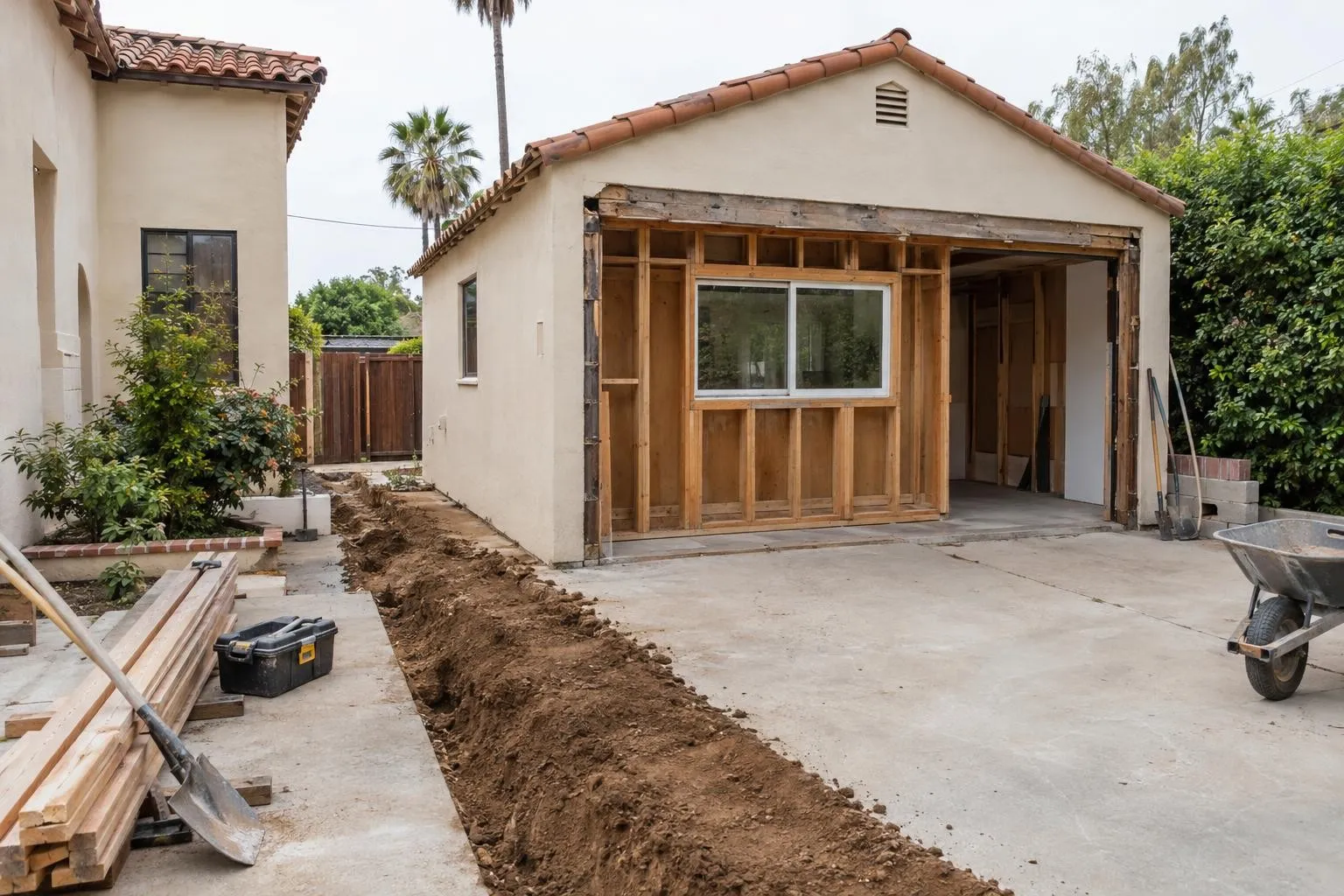
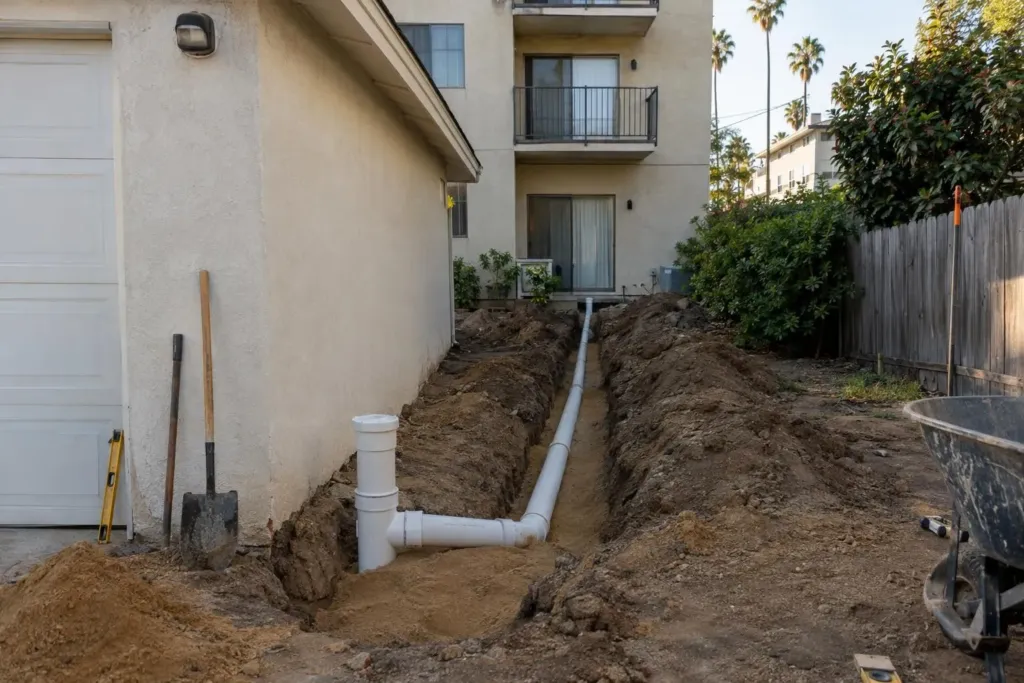
Usually yes. The new drain line normally runs underground from the garage and joins the house's building sewer outside the foundation. The hard part is keeping a steady downhill slope the whole way.
Sewer lines work by gravity, so the pipe has to fall steadily from the ADU to the point where it joins the existing line. In a lot of Los Angeles homes the garage sits at the back of the lot and the house sewer leaves from the front or side. That can mean a long trench and very little room to keep the slope. Older lots that tilt toward the alley make this harder.
The LA County homeowner’s guide for ADUs gives sensible rules for unincorporated areas:
- Put a two-way cleanout just outside the ADU’s sewer connection. A cleanout is a capped opening that lets a plumber run a snake or camera down the line.
- Install a backwater valve when the line can’t keep a 2 percent fall to the downstream connection. A backwater valve is a one-way flap that stops sewage from flowing backward into the unit.
- Don’t run clay pipe or a sewer line under any structure.
City of Los Angeles plan check applies its own requirements, but the physics are the same. If the garage floor sits lower than the house line, the plumbing designer may call for a sewage ejector pump. That’s a sealed basin with a pump that lifts waste up to the gravity line, and the city reviews it like any other plumbing. Before anyone trenches, call 811 through DigAlert so the utilities mark their lines. Keep in mind that 811 won’t mark private lines on your lot, like a gas line to a backyard heater.
Should I camera-inspect the old sewer line before design?
Yes. We treat it as a smart step, not a city mandate. A camera inspection shows whether the line your ADU will drain into is cracked, full of roots, or old clay pipe before you commit to a plumbing layout.
Many older Los Angeles homes still have their original clay sewer pipe. Clay joints shift over decades, and roots from street trees and backyard trees work into those joints. The house may drain fine today, then back up once a kitchen, shower, and washer in the garage start sending water down the same line.
A camera inspection also shows where the line actually runs and how deep it sits. That tells the designer whether the ADU can tie in by gravity and where the connection should go. Do it before the plans are drawn, not after the permit is issued.
If the camera finds a failing line, that’s the house’s existing problem, but you’ll want it fixed as part of the project. The fix might be replacing a section, replacing the whole lateral, or another repair method designed to meet city requirements. Work in the public right of way, like the sidewalk or street, needs its own city permit. Our guide to budgeting garage conversion costs explains how to leave room for findings like this.
Do I need a separate electric meter for the ADU?
Not as a blanket rule. A conversion ADU can usually be fed from the main house panel through a subpanel, and LA County guidance calls a separate meter optional. A second meter is a choice you make for billing or rental reasons.
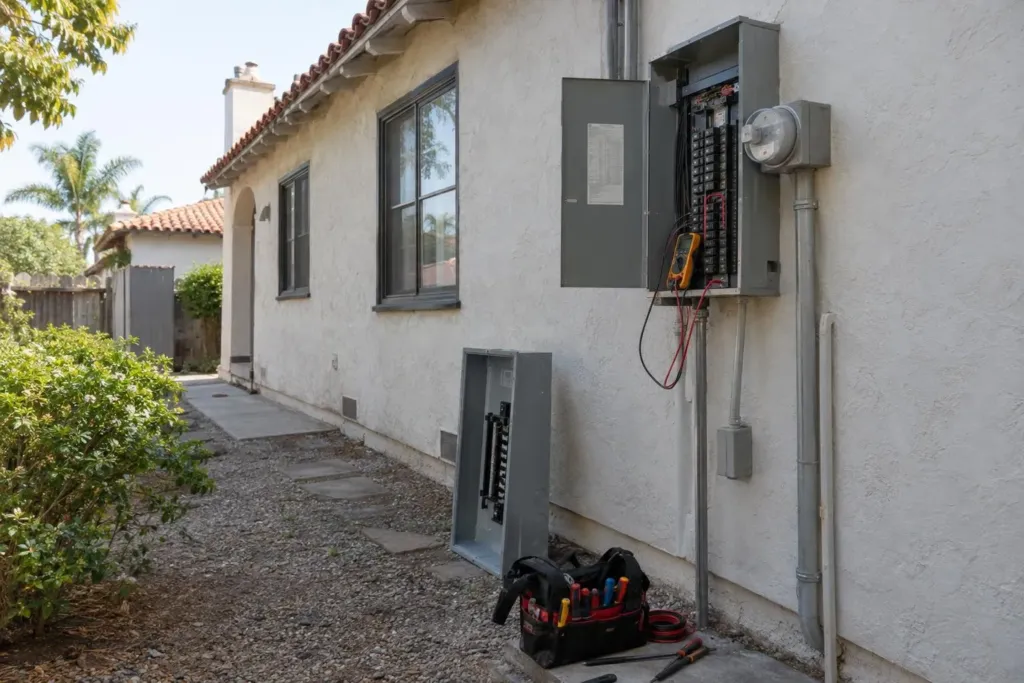
A subpanel is a smaller breaker box in the ADU, fed by one large circuit from the main panel. It’s the most common setup for a conversion. It keeps the work on your property and avoids a new utility service. We found no official LADWP rule requiring a separate meter for every ADU, so be skeptical of anyone who says it’s mandatory.
A separate meter does have real benefits for a rental. The tenant pays their own power bill, and it changes who gets billed for the per-unit city sanitation charge. The downside is that you’re asking for a new service. That brings LADWP’s requirements, more equipment on the wall, and a longer list of inspections.
A JADU is a junior ADU, a small unit carved out of space inside the main house. LA County guidance says a JADU isn’t treated as a separate dwelling unit for water, sewer, or power service, and it doesn’t need its own meter or address. Outside the City of Los Angeles, the rules come from a different office. Unincorporated areas follow LA County Public Works, and some areas get power from Southern California Edison or a city-owned utility with its own service process.
How do I know if my electrical service can handle the ADU?
A load calculation tells you. An electrician or designer adds up what the house and the ADU will draw, using the code's method, and compares it with what your service can carry. If it fits, you don't need an upgrade; if it doesn't, you upgrade the service or reduce the load.
Your service size, like 100 amps or 200 amps, is the most power your panel and the utility feed can safely deliver. Many older Los Angeles homes have small services, and some still have fuse boxes or panels that are worn out. Those homes are more likely to need an upgrade, but it isn’t automatic. A 100-amp house with gas appliances and modest use may have room for a small ADU. A 200-amp house with an EV charger and electric everything may not.
Your appliance choices drive the number. An all-electric ADU with a heat pump water heater, induction range, heat pump heating and cooling, and an electric dryer adds real load. Running gas to the garage can lower the electric load, but it adds another trench and another set of inspections. Neither choice is right for every lot. The load calculation shows the tradeoff on paper.
Watch for warning signs in your current panel:
- Breakers that trip often or feel warm.
- Lights that dim when the AC or dryer starts.
- Scorch marks, buzzing, or a burning smell at the panel.
- Two wires crammed under one breaker screw.
Any of those means the panel needs attention whether you build an ADU or not. City plan check reviews the load calculation as part of your ADU sewer and electrical design, so it pays to get it right before submittal.
What is the LADWP process for a service upgrade or new meter?
You apply to LADWP, LADWP sets the requirements, your contractor builds to them, and both LADWP and LADBS inspect before the power is turned on. Each agency controls its own steps and its own timing.
The LADWP Guide to Electric Service lays out the order:
- You or your contractor apply to LADWP for the service upgrade or new meter.
- LADWP reviews the site and sets the requirements, such as meter location and conduit route.
- Your contractor installs the conduit, and LADWP inspects it.
- Your contractor installs the new panel, and LADBS inspects it and releases the meter panel.
- LADWP energizes the service and sets the meter.
Start the LADWP application early. Their requirements can affect where the panel goes, and that affects your plans. LADWP decides how long the power stays off during the cutover, and that time can vary. Ask about it ahead of time and plan around food, medical equipment, and tenants.
Overhead lines are worth checking too. If power lines cross over the garage or run close to it, raise that with LADWP before design. Don’t rely on clearance numbers you read online. LADWP and the city building department decide approvals and timing at each step, and no contractor can speed that up for you.
When should you call a licensed contractor about ADU sewer and electrical work?
Call before your plans are drawn if the garage sits low on the lot, the house sewer is old clay pipe, your panel is small or showing warning signs, or the garage is near an easement or power lines. Each of those can change the design, and finding out at the first inspection costs time. A licensed and insured general contractor can camera the line, order the load calculation, and coordinate the city clearances and LADWP steps in the right order. Villa Bella Construction looks for what’s really driving the problem first. Then we recommend targeted sewer and electrical work designed to meet city requirements, without tearing out more than your conversion needs.
Villa Bella Construction is a licensed and insured general contractor, building in Los Angeles for 25 years. CSLB License #1093648 (B – General Building).
Call +1 (323) 825-9798 or send us your project details.
Learn more: ADUs and garage conversions.
Planning a construction or remodeling project in Los Angeles?
Schedule a Free On-Site Consultation or call +1 (323) 825-9798.