Key Takeaways
- There's no reliable flat price for a driveway replacement in Los Angeles. A real number depends on what an on-site assessment finds.
- The soil under the slab, site access, slope, and tree roots move the price more than the concrete itself does.
- The apron, curb cut, and street tree sit in the public right-of-way, so they need city permits, and the owner pays for that work.
Your concrete driveway replacement cost in Los Angeles depends mostly on what’s under the old slab, how hard the site is to reach, and whether the job touches the apron, curb, or street tree in front of your house. The concrete itself is rarely the big driver. Prices you find online come from national sites and often leave out demolition, base work, and permits. That’s why a real number needs an on-site assessment. Below you’ll find what a fair bid includes, when repair beats replacement, which agencies get involved, and how the job runs from start to finish.
How much does concrete driveway replacement cost in Los Angeles?
There's no honest single number, because the price depends on what an on-site assessment finds under and around the slab. Demolition, base repair, access, slope, and city work in the right-of-way move the total more than square footage does.
Be careful with the per-square-foot figures you see online. Many leave out demolition and haul-away, and those two items can be a large share of the job. Breaking out an old slab is slow, heavy work. If the old driveway was poured thick or has steel in it, removal takes longer, and every truckload of broken concrete costs money to dump.
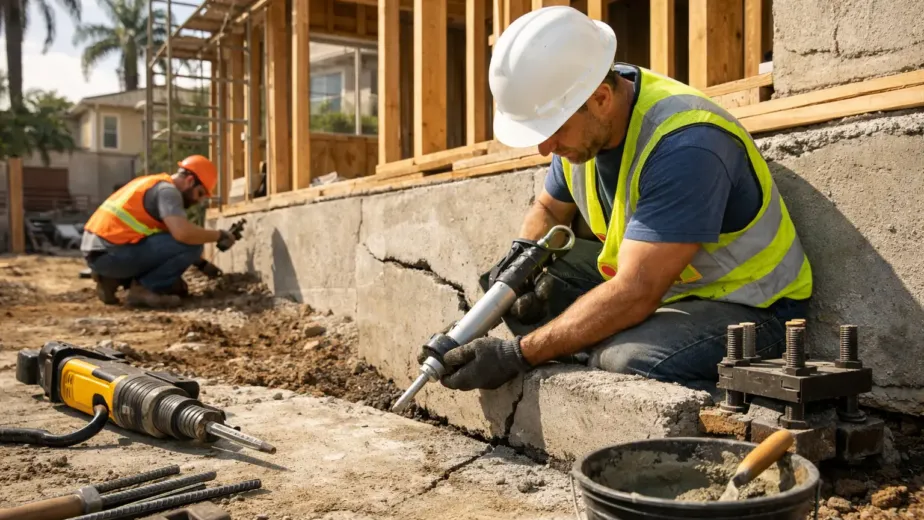
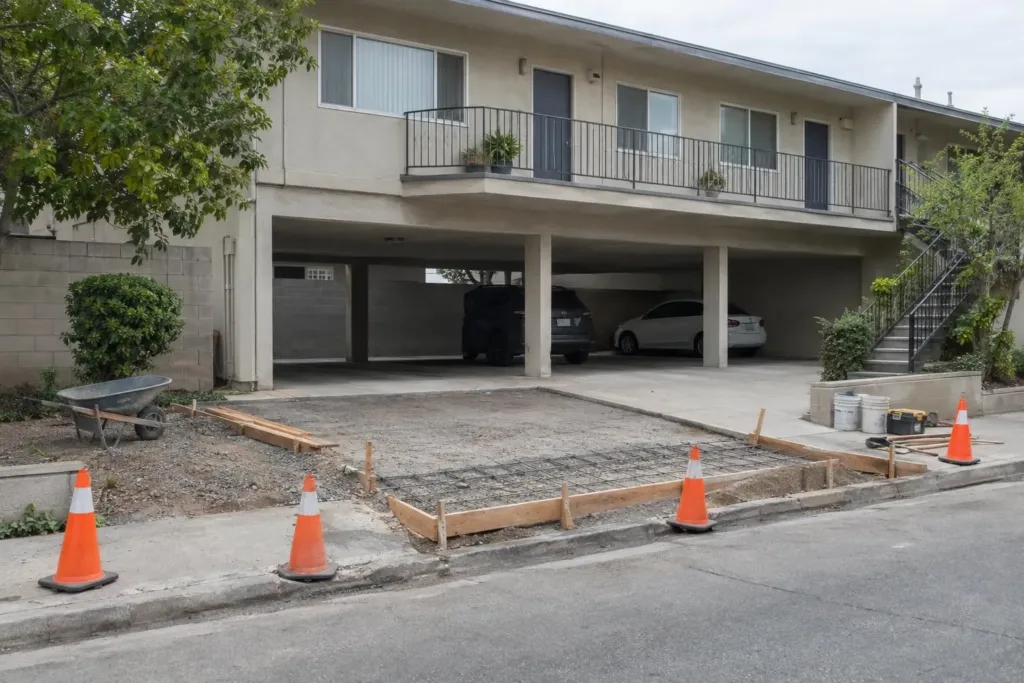
Base work is the next big piece. The base is the layer of compacted gravel the new slab rests on. If the old driveway sank or cracked because the ground under it was soft, that ground has to be dug out and rebuilt before anyone pours. Skip it and the new driveway tends to fail the same way the old one did.
Other things push your concrete driveway replacement cost up or down:
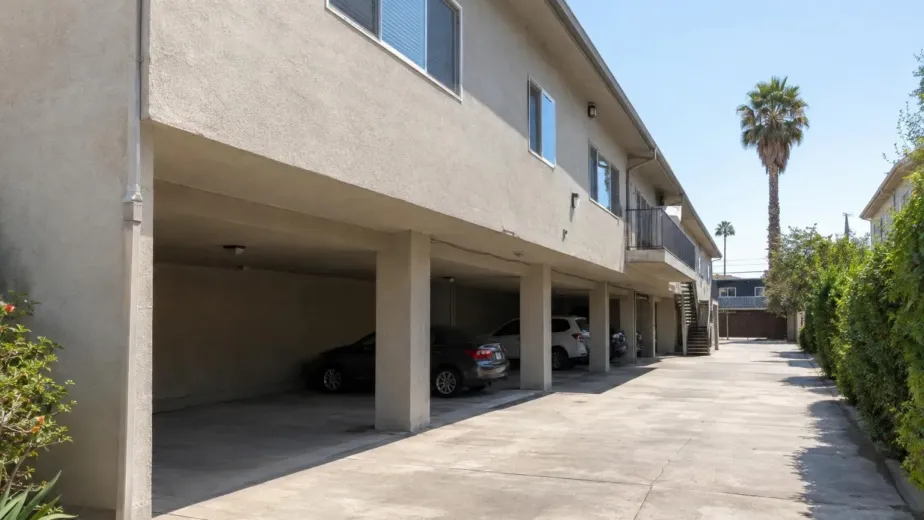
- Access. A straight shot from the street is easier than a narrow side yard where crews wheelbarrow everything.
- Slope. Steep driveways need more forming, more care, and sometimes a concrete pump.
- Finish. A plain broom finish is the simplest. Stamped, colored, or exposed-aggregate finishes add labor and material.
- City work. Replacing the apron or curb, or root pruning a street tree, adds permits and extra work.
Two driveways of the same size can be priced far apart because of what’s underneath them and how hard they are to reach.
What should a driveway replacement bid include?
A good bid lists every part of the job on its own line, from demolition to cleanup, so you can compare contractors fairly. If an item isn't written down, assume it isn't included.
When you lay two bids side by side, check that each covers the same scope. A complete driveway bid usually lists:
- Demolition and haul-away of the old concrete
- Excavation, imported base material, and compaction
- Slab thickness, written as a number
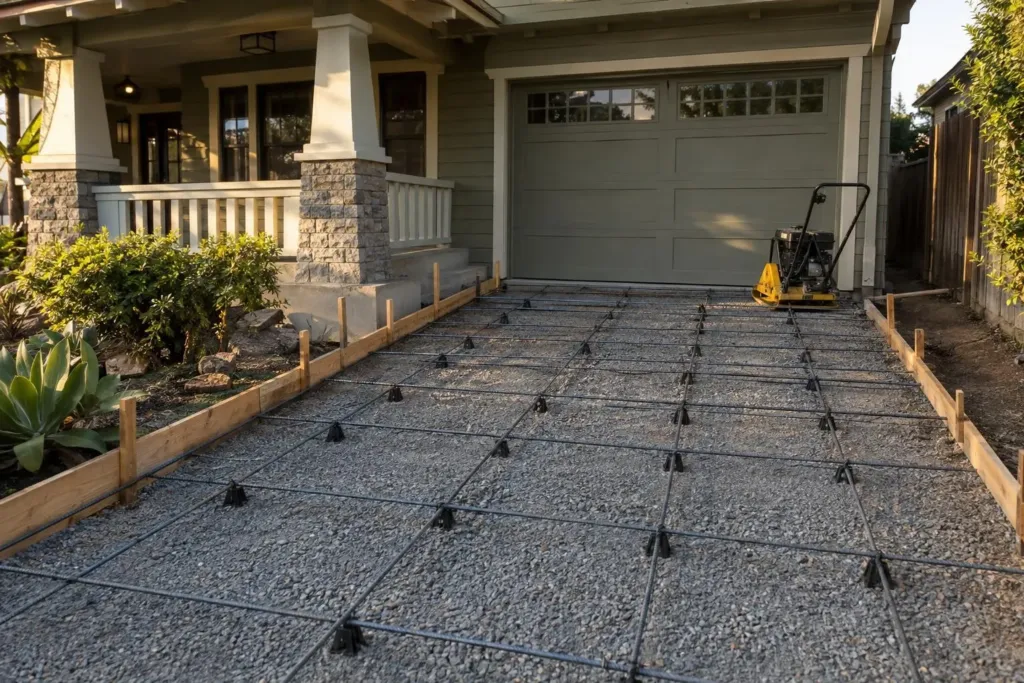
- Reinforcement, meaning rebar or wire mesh
- Forms, control joints, finish type, and curing
- Drainage work, such as regrading or a trench drain
- Apron, curb, or sidewalk work, and who pulls the city permit
- Tree root work, and who gets the tree permit
- Cleanup and protection of nearby surfaces
Look closely at thickness. The city’s driveway data sheet lists 4 inches for a residential approach in the public right-of-way, but thickness for your private slab is a design decision the contractor should explain in writing. Weak soil or heavy vehicles are good reasons to go thicker or add steel. Rebar won’t make up for a poor base, though. It only helps hold cracks together.
Before you sign, look up the contractor’s license on the Contractors State License Board website and make sure it’s active and matches the name on the bid. Our driveway, block wall, and retaining wall services page explains how we scope concrete work that ties into walls and slopes.
Should I repair, resurface, or fully replace my cracked driveway?
Repair makes sense when damage is limited to one section and the ground underneath is still solid. Resurfacing only covers the top layer, so it won't fix settling or lifting. Full replacement is the right call when the slab has sunk, heaved, or cracked across many panels.
Start by looking at how the slab is moving. Thin hairline cracks that stay level on both sides usually come from shrinkage, the normal tightening concrete does as it dries. Those can often be sealed and left alone. When one side of a crack sits higher than the other, the ground below has moved, and patching the surface won’t stop it.
Resurfacing means bonding a thin new layer over the old concrete. It works on sound concrete that only looks worn. On a slab that’s settling or being pushed up by roots, the new layer cracks right along with the old one.
Partial replacement sits in the middle. If one or two panels near the street broke from a root or a soft spot, you may be able to cut out just those panels and rebuild the base under them. Our post on concrete driveway and slab repair covers those smaller fixes.
Signs that point to full replacement include trip edges across several panels, water pooling against the garage, patches that keep failing, and crumbling edges along the whole length. If you’re unsure what a crack means, read how to tell if a slab crack is structural or just shrinkage.
Do I need a permit to replace a driveway in Los Angeles, and who issues it?
In the City of Los Angeles, the private slab on your lot and the approach at the street fall under different departments. The approach, including the apron and curb cut, needs a permit from the Bureau of Engineering. Grading, retaining walls, or drainage changes on your lot can bring in the building department.
Think of your driveway as two parts. The private slab runs from the garage to your property line. The approach is the sloped piece from the sidewalk down to the street, including the apron, the curb cut, and the parkway strip. Because the approach sits in the public right-of-way, the Bureau of Engineering handles it, not the Los Angeles Department of Building and Safety (LADBS).
The Bureau of Engineering’s driveway construction, modification, or replacement procedure explains that it reviews new, changed, and replaced approaches, checking for water meters, street trees, and shared driveways. The permit for this work is called an A-Permit.
Don’t assume the private slab is always permit-free. On a hillside lot, regrading the driveway, rebuilding a retaining wall beside it, or changing where water drains can bring LADBS into the job.
These two departments cover only the City of Los Angeles. Other cities have their own building and public works departments, and unincorporated areas go through Los Angeles County Public Works. In every case, the agency decides approvals and timelines, so plan around its review.
What changes if I want to replace or widen the apron and curb cut?
Replacing the apron as it is needs an A-Permit from the Bureau of Engineering. Widening it adds more review, including a driveway data sheet approved by the transportation department on many streets. There are width limits, and the approach has to lead to a legal parking area on your lot.
The permit application asks whether you’re replacing the full approach or just part of it. The Bureau of Engineering’s permit processing procedures explain that a partial replacement is listed as its own quantity. You also pick the driveway type and the material, concrete or asphalt.
Widening is where homeowners get surprised. For approaches on local streets, collector streets, Avenues, and Boulevards, the Los Angeles Department of Transportation must approve a Driveway Approach Data Sheet before the A-Permit is issued. That sheet limits an apron serving a residential lot to 18 feet wide, measured along the curb.
The city also won’t approve an approach that doesn’t lead to a legal parking spot on your property, and its guidance says driveway width should match the garage width.
Before paying for a design, check what’s in the way. A water meter, hydrant, utility pole, or street tree inside the new apron footprint can limit where the driveway goes, and moving any of them means more permits and more cost.
Who pays when a city street tree's roots lift my driveway?
In the City of Los Angeles, the property owner is responsible for the sidewalk, curb, parkway, and driveway approach, even when a street tree caused the damage. The city does not root prune for you, and you need a permit before cutting roots or removing a street tree.
Street tree roots are one of the most common reasons Los Angeles driveways crack. In older neighborhoods, big parkway trees planted decades ago send roots under the apron and into the first panels of the private slab. You’ll usually see a raised ridge near the street with cracks spreading from it.
StreetsLA’s Urban Forestry Division lets owners root prune at their own expense after getting a permit. Its tree policies and guidelines say removal is considered only in limited cases, including off-grade driveway or apron replacement, and only after review. Don’t plan your project around the tree coming out. It may have to stay.
Never cut street tree roots without that permit. Cutting the wrong roots can make the tree unstable and lead to penalties.
For trees on your own lot, your contractor may suggest a root barrier, a better-reinforced slab near the tree, or a layout that keeps concrete away from the trunk. Each adds cost, but they help the new slab last.
How do hillside lots and clay soils change the concrete driveway replacement cost?
Steep lots and clay soils usually raise the price because they need more digging, a better base, and careful drainage. Access is often harder too, so crews may need a pump and extra labor.
Much of Los Angeles sits on expansive clay, soil that swells when wet and shrinks when dry. Over the years that movement lifts and drops a slab until it cracks. On clay, a good contractor usually digs deeper, brings in more base, compacts it in layers, and keeps water away from the slab.
Hillside driveways add their own problems. The Bureau of Engineering’s street design guidance says grades should avoid abrupt changes where the public approach meets the private driveway, so cars don’t scrape. It also says the cross slope, meaning the side-to-side tilt, shouldn’t go over 10 percent. Meeting both on a steep lot takes careful layout.
Water is the bigger worry. Runoff on a steep driveway picks up speed and heads for the garage or the low edge. If it soaks in at the edges, it washes out the base and the concrete breaks. Our guide on planning hillside foundation drainage explains how water moves on these lots.
If a retaining wall holds up the side of the driveway, check it before you pour. A leaning wall can take a new slab down with it, and wall work can bring in LADBS review.
What happens during the job, and do I have to call DigAlert first?
Yes. California law requires a call to DigAlert, also known as 811, at least two working days before digging, not counting the day you call. After that, the job follows a set order from demolition through curing, with city inspections where a permit applies.
Shallow utility lines are common under Los Angeles driveways, especially near the street. A gas line, water line, or electrical feed can sit just inches below the slab. DigAlert’s safe digging guidance notes the service is free, and utilities usually mark only the lines they own, typically up to the meter. Lines on your side of the meter may need to be found another way.
A typical replacement goes in this order:
- Get the needed permits, such as the A-Permit for the approach and any tree or grading permits.
- Call DigAlert and wait for the utility markings.
- Break out and haul away the old concrete.
- Dig out soft soil and fix any root or drainage problems.
- Bring in base material and compact it in layers.
- Set forms and reinforcement, then pass any required city inspection.
- Pour, finish, and cut control joints.
- Let the concrete cure before foot traffic and before cars.
Control joints are the straight grooves cut into the slab. They give the concrete a planned place to crack, so cracks stay neat instead of wandering.
Ask for a written wait time before walking and before driving on the slab. Cars need much longer than feet, depending on the mix and the weather. Where an inspection is required, the agency sets the schedule, so build in some slack.
When should I call a licensed contractor about my driveway?
Call a licensed and insured general contractor when your driveway has panels that have sunk or lifted, water running toward the house or garage, or a raised apron near a street tree. Call before you start if you want to widen the approach or change the curb cut. Those jobs involve city permits, utility markings, and sometimes tree or grading review.
Villa Bella Construction starts by finding out why the old driveway failed, whether that’s roots, soil, drainage, or a weak base. Then we recommend the most targeted repair or replacement the city will accept. A site visit is the only way to get a real number, because what’s under the slab decides most of the cost.
“Steve is very knowledgeable and easy to work with.” — M. A., Yelp review
Villa Bella Construction is a licensed and insured general contractor, building in Los Angeles for 25 years. CSLB License #1093648 (B – General Building).
Call +1 (323) 825-9798 or send us your project details.
Learn more: Retaining walls, block walls, concrete slabs, driveways, foundation repair.
Planning a construction or remodeling project in Los Angeles?
Schedule a Free On-Site Consultation or call +1 (323) 825-9798.