Key Takeaways
- A fire damaged home inspection is several separate checks: the insurance adjuster, the engineer and licensed trades, and the city building inspector.
- An asbestos survey is required before demolition or cleanup, and lead testing matters in older homes.
- Most fire repairs need a permit, and the building department that covers your address decides approvals and timelines.
A fire damaged home inspection is not one visit. It’s a series of checks by different people. The insurance adjuster prices the claim. A structural engineer and licensed trades decide what is still sound. The city building inspector checks the permitted repair work as it happens. If you know who does what, and in what order, you won’t tear out good material, skip a required test, or pay twice for work that fails a city inspection.
What is a fire damaged home inspection, and how is it different from the adjuster's visit?
It's a set of separate evaluations, not one appointment. The adjuster looks at the loss for your insurance company, engineers and licensed trades decide what can stay, and the building department inspects the permitted repairs. Each one answers a different question, and none of them replaces the others.
The adjuster works for the insurer and writes up what the policy should pay for. A restoration company’s “free inspection” is usually a cleanup estimate. Neither one tells you whether a beam can still carry weight or whether the wiring is safe to turn back on.
Licensed professionals decide what to keep. A structural engineer is a licensed professional who works out how a building carries weight, and that person judges the framing and foundation. A licensed electrician and a licensed plumber check their systems. An asbestos consultant tests materials before anyone disturbs them.
The city inspector comes later and has a narrow job: confirming that the repair work matches the permit and the code. That inspector doesn’t certify the whole house as safe, and doesn’t check for smoke or odor.
Here is the order that usually works:
- Get the all-clear to enter from the fire department or the building official.
- Photograph everything before anything is moved or thrown out.
- Test for asbestos, and for lead in older homes, before cleanup or demolition.
- Bring in the engineer and licensed trades to evaluate the structure and systems.
- Open walls and ceilings only where the engineer needs to see more.
- Pull permits for the repair scope, then schedule city inspections as the work moves along.
When is it safe to go back inside, and who decides?
The fire department and the local building official decide when a damaged house can be entered, and they may post a sign on it. Once you're allowed in, a structural engineer is the right person to say whether damaged areas are stable enough for work to start.
After a fire, officials may post a placard on the house. It’s a sign that shows whether the building is safe, restricted, or unsafe to enter. Follow it. If you’re not sure what yours means, call the department that posted it.
Some warning signs mean you should stay out until an engineer has looked:
- A sagging roof line or a ceiling that bows down.
- A floor that feels soft or bouncy.
- Doors that suddenly stick.
- Long new cracks in stucco near corners.
Wet drywall is heavy with firefighting water and can fall without warning. When a section might collapse, the contractor may install temporary shoring before anyone works inside. Shoring is posts and beams that hold the structure up while it’s evaluated. The best way to do it is to follow the engineer’s direction.
When you do go in, wear sturdy shoes, gloves, and a properly fitted respirator. Keep kids and pets out. Ash and soot hold fine particles and chemicals you don’t want to breathe or track into your car.
Do I need a structural engineer, and will walls have to be opened?
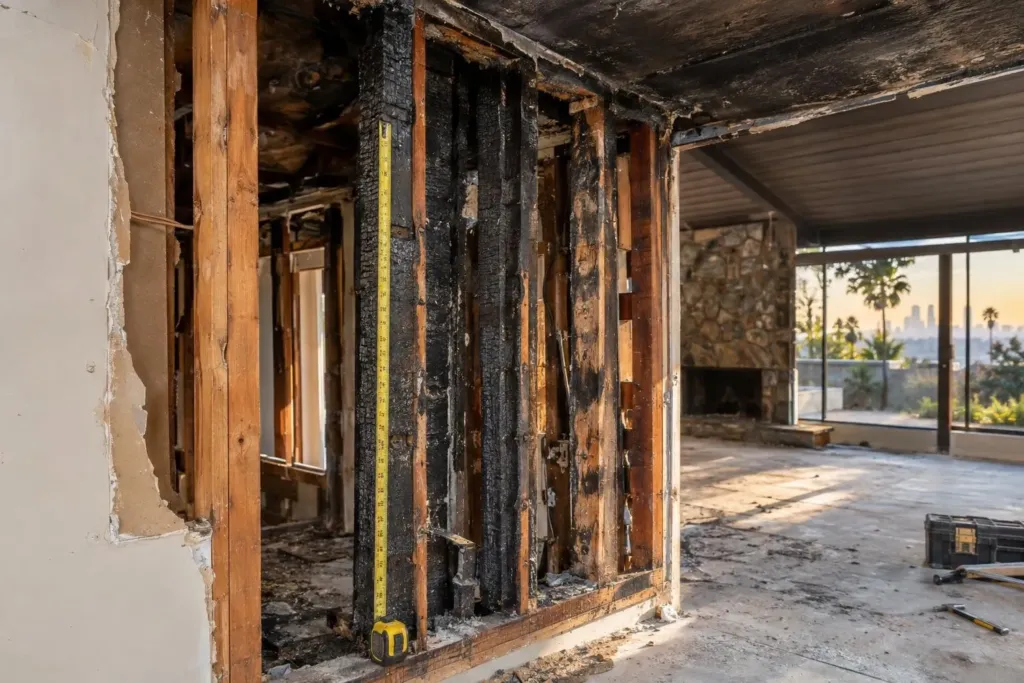
If the fire reached the framing, roof, or foundation, or if hose water soaked the structure, you need a structural engineer. The engineer usually needs a few walls and ceilings opened, because the real damage often hides behind finished surfaces.
Burned wood loses strength in two ways. The charred outer layer no longer carries load, and the wood just under it can be weakened by heat. The engineer measures char depth, which is how far the burn went into each piece. Then the engineer decides whether each joist or stud still has enough sound wood left. Our post on fire damaged framing repair explains how that save-or-replace call gets made.
The engineer often asks for selective exploratory demolition. That means cutting out small, targeted sections of drywall or ceiling so the framing can be seen. It isn’t a full tear-out. Done carefully, it answers the question without destroying finishes that could have stayed.
Water is the second problem. Fire hoses can soak subfloors, insulation, and the wood sitting on the foundation. In older Los Angeles homes with raised floors, that water often collects in the crawlspace and sits there for weeks. Read about finding hidden water damage after a house fire before you assume a room is fine just because it didn’t burn.
Heat also affects metal and concrete. Ask the engineer to check hold-downs, the steel hardware that ties walls to the foundation. Also ask about any concrete near the hottest areas for spalling, which is when the surface flakes or pops off.
Do I need asbestos and lead testing as part of a fire damaged home inspection?
Yes. South Coast AQMD requires an asbestos survey by a Certified Asbestos Consultant before demolition or renovation, even after a fire and no matter how old the home is. In older homes, lead paint testing should also happen before anyone sands, scrapes, or tears out painted surfaces.
The South Coast AQMD emergency demolition guidance says that even after a sudden event like a fire, the owner still needs an asbestos survey first. The owner also has to file the emergency notification as soon as possible. A Certified Asbestos Consultant is a state-certified specialist who takes samples and sends them to a lab.
Fire makes asbestos more dangerous. Heat and water break down materials like old popcorn ceilings, duct wrap, flooring, and some joint compounds, so fibers can come loose. AQMD treats damaged asbestos material differently and requires an approved cleanup plan before it can be removed. Don’t assume a newer-looking house is exempt. The survey is required regardless of age.
Lead is the other concern in homes built before 1978. The U.S. EPA’s Renovation, Repair and Painting rule requires certified firms and lead-safe work practices when painted surfaces are disturbed in older homes. Cal/OSHA also has its own rules to protect workers from lead and asbestos.
Testing first protects your family, the crew, and your neighbors. It also keeps the cleanup from being stopped halfway because someone disturbed regulated material without a survey.
How are the electrical, gas, and plumbing systems checked, and who turns utilities back on?
A licensed electrician and a licensed plumber check their systems, and the utility companies decide when service comes back. Electrical repairs need a permit and a city inspection, and the gas company does its own safety check before relighting.
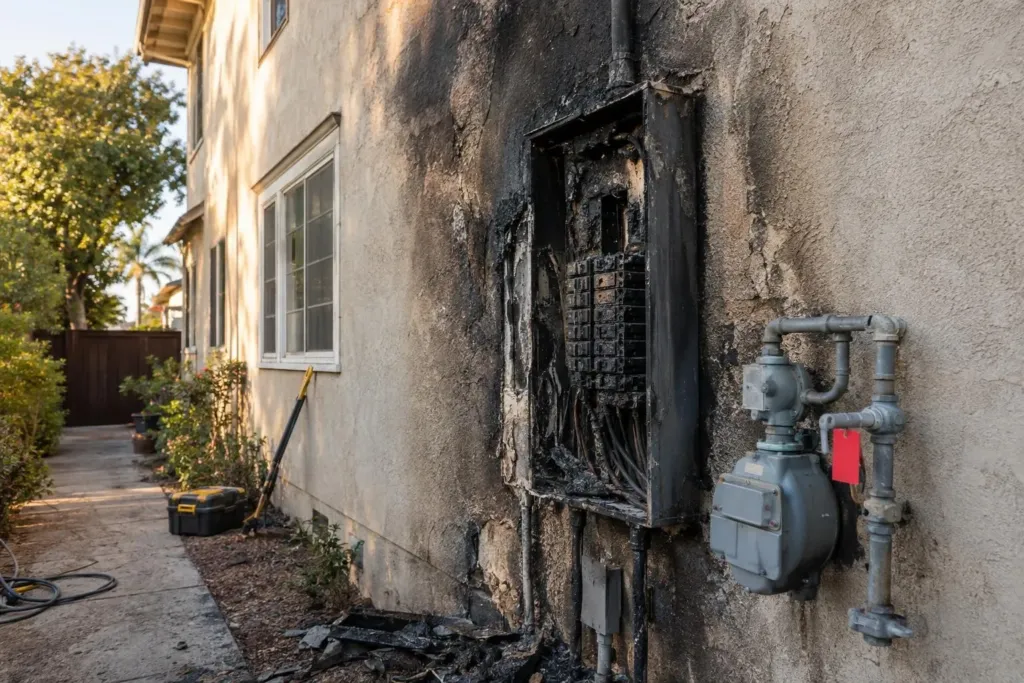
Wiring that looks fine can be damaged by heat inside its insulation, or corroded by water. Breakers and panels that got hot may not trip when they should. Only a licensed electrician should decide what stays. Repairing damaged wiring needs a permit and a city inspection before the power company reconnects the house.
Plastic pipes such as PEX, PVC, and ABS soften at much lower temperatures than copper. That doesn’t mean copper gets a free pass. A licensed plumber should pressure-test the water lines, run a camera through the drains where needed, and check the water heater and its venting.
Don’t test gas yourself. If the meter was shut off, SoCalGas does a safety check and relights the appliances once the house and its gas piping are ready. A plumber may have to pressure-test the house gas lines first.
In the City of Los Angeles, LADWP provides power and water. The LADBS wildfire information page points to LADWP’s rules for replacing customer-owned plumbing and restoring service. Outside the city, SCE or another local utility handles power. Also have the heating and cooling ducts checked before you run the system. Ducts can push soot into rooms that were clean.
Do fire repairs need a permit, and what will the city inspector check?
Yes, most fire repairs need a permit from the building department that covers your address. Smaller repairs may qualify for a simpler permit, while bigger damage needs plans and engineering reviewed first. The building department decides approvals and timelines, so plan around its schedule.
Which agency issues the permit depends on where the house is. LADBS covers only the City of Los Angeles. Unincorporated county areas go through LA County Public Works, and every other city has its own building department. Check your address before you assume anything.
LADBS offers express permits for some smaller residential fire repairs. An express permit is issued without plan check, which is the city’s review of drawings before work starts. Larger damage, especially to framing, the roof, or the foundation, needs drawings and engineering reviewed first. Ask the building department which path your damage qualifies for. That call is theirs.
During the job, the inspector usually comes at these points:
- Foundation or new footings, before concrete is poured.
- Framing, hardware, and structural repairs, before walls are closed.
- Rough electrical, plumbing, and mechanical work.
- Insulation and energy items.
- Final inspection and sign-off on the permit.
Once walls are open, current code can apply. That includes energy rules, construction waste recycling, and fire-resistant construction in Very High Fire Hazard Severity Zones. Badly damaged hillside homes may also need soils and geology reports. Our article on rebuilding to current code after a fire explains what usually gets triggered.
How do I prove what my house had before the fire?
Start with the city's permit records and the Certificate of Occupancy, then add your own photos and plans. Together, these help the building department, your engineer, and your insurer agree on what legally stood on the lot.
A Certificate of Occupancy is the city document confirming a building was approved for use. Permit records show what was built or added legally over the years. The same LADBS wildfire page explains how to get parcel information and copies of permits and the Certificate of Occupancy for your property.
Unpermitted work can cause problems. A bedroom, bathroom, or garage conversion that was never permitted may not be rebuilt as it was. Find this out early, before the drawings are done and before you agree to a settlement number.
Collect your own evidence too. Look for old phone photos, listing photos from when you bought the house, original plans, and any inspection cards left from past permits. Even blurry pictures of a kitchen or a ceiling help show what was there.
Write down what happened during the fire while you still remember it clearly. Note where it started, which rooms firefighters cut into, and which utilities were shut off. Your engineer and contractor will use that list to decide where to look first.
How does a fire damaged home inspection support my insurance claim?
Engineer and trade reports give your claim facts instead of guesses, and they show hidden damage an adjuster may miss on a walk-through. The California Department of Insurance advises getting at least one licensed contractor's estimate of your own.
The California Department of Insurance tips for wildfire claimants recommend at least one licensed contractor’s estimate. CDI also tells owners to check the contractor’s license and explains the minimum time to collect additional living expenses (ALE) after a declared catastrophe. ALE is the money your policy pays for housing and extra costs while you can’t live at home.
Whether your policy pays for testing, engineering, or code upgrades depends on its wording. Read it, and ask your insurer in writing. Keep a claim diary that lists the date, the person you spoke with, and what was said. If you hire a public adjuster, confirm that person is licensed by CDI.
Check every license before work starts. You can look up contractors on the Contractors State License Board website. The state engineering board licenses structural and civil engineers. For more on what to ask, see how to choose a fire damage restoration contractor.
When should you call a licensed contractor after a fire?
Call a licensed contractor once you’re cleared to enter and the asbestos survey is in motion. Call sooner if you see sagging, water soaking the floors, or an adjuster’s scope that doesn’t match what you’re seeing. A good contractor coordinates the engineer, the trades, and the city inspections so the work happens in the right order.
Villa Bella Construction is licensed and insured, and our fire damage rebuilding work starts with finding the real extent of the damage. We keep what is sound, replace what isn’t, and recommend the safest targeted repair the building department will accept. The goal is to avoid tearing out more of your home than the fire actually damaged.
“If you want an honest, licensed contractor in the LA area, I highly recommend them!” — Robert H., Google review
Villa Bella Construction is a licensed and insured general contractor, building in Los Angeles for 25 years. CSLB License #1093648 (B – General Building).
Call +1 (323) 825-9798 or send us your project details.
Learn more: Fire damage rebuilding.
Planning a construction or remodeling project in Los Angeles?
Schedule a Free On-Site Consultation or call +1 (323) 825-9798.