Key Takeaways
- Stay out until officials clear the house, then protect it and document everything before anything is cleaned or thrown away.
- Find out whether the damage is a targeted repair or a full rebuild before anyone starts demolition.
- Every repair or rebuild needs permits and must meet current building and fire codes, and the building department decides approvals and timing.
A fire damaged home recovery guide comes down to one order of work. First, stay safe. Then document everything, get the structure assessed, and permit and rebuild only what the damage really requires. Rushing cleanup or tearing out too much too early can hurt your insurance claim and make the rebuild bigger than it needs to be. Below are the questions Los Angeles owners ask most in the weeks after a fire, answered the way we’d explain them to a neighbor.
What does a fire damaged home recovery guide say to do first?
Stay out of the house until the fire department or building officials say it's safe to enter. After that, call your insurance company and protect the property from more damage before anyone starts cleaning.
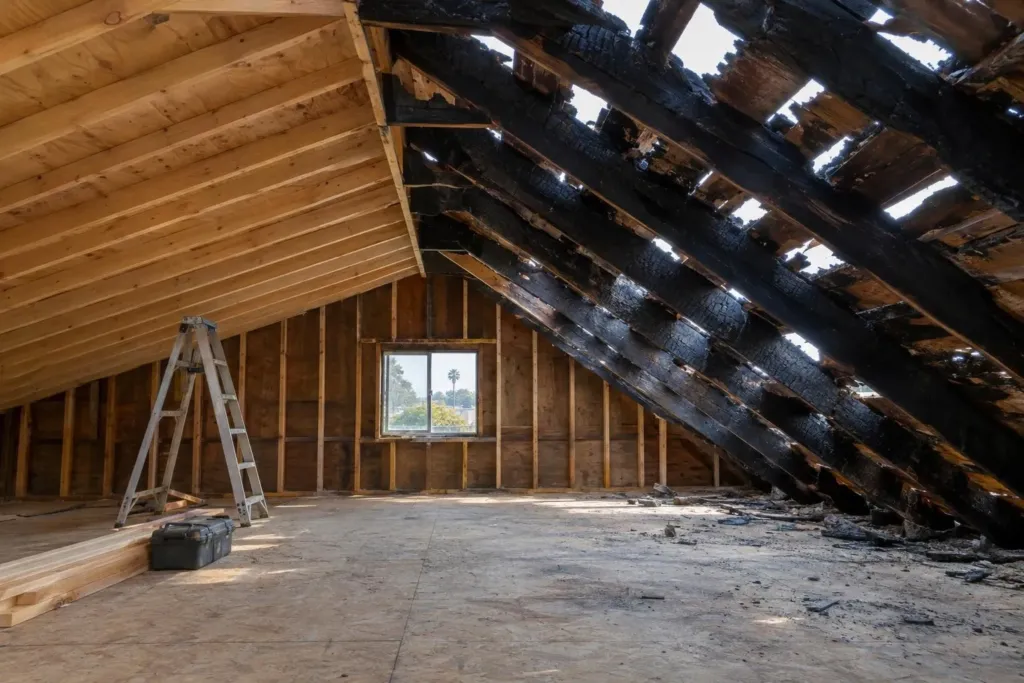
A house can look solid after the flames are out and still be unsafe. Heat weakens wood framing, metal connectors, and roof sheathing even where you don’t see black char. Sheathing is the plywood or boards nailed over the rafters. Firefighting water adds weight to ceilings, and soaked drywall or plaster can come down days later.
Once you’re allowed back in, think about protection, not repair. Board up broken windows and doors, cover holes in the roof, and keep utilities off. The utility companies decide when gas and power come back on, and they usually wait until damaged systems have been repaired under permit and inspected. Keep every receipt for this emergency work.
In older Los Angeles homes with raised wood floors, the water doesn’t stay on the surface. It runs through the subfloor into the crawl space and sits against the framing and the foundation. Getting that area dried out early is one of the most useful things you can do in the first week.
What should I document for insurance before cleanup starts?
Photograph and video every room, the outside of the house, and your damaged belongings before anything is removed. Keep a written inventory and every receipt, and request the fire report.
Good records are the backbone of your claim. Work through them in this order:
- Walk room by room with video running, and say out loud what you’re looking at.
- Take close-up photos of charred framing, smoke stains above doorways and vents, and water lines on walls and floors.
- Write an inventory of damaged belongings with rough age and value, room by room.
- Ask the fire department that responded for a copy of its fire report.
- Save receipts for board-up, hotels, meals, storage, and anything else the fire forced you to pay for.
Don’t throw out damaged items until the adjuster has seen them or agreed in writing. If you get rid of them too soon, it can be harder to get paid for them.
Document rooms that look fine, too. Smoke travels through the heating ducts and the attic, so closets and bedrooms far from the fire often hold soot and odor you won’t notice on the first walk-through.
Will insurance pay for somewhere to live while the house is repaired?
Many homeowner policies include additional living expense coverage, often called ALE, which pays the extra cost of living away from home. It pays the difference above your normal living costs, up to your policy limits, so you'll need to track every expense.
The California Department of Insurance explains on its guidance for policyholders after a wildfire that ALE can cover housing, food, furniture rental, relocation, and storage. How long it lasts and how much it pays depend on your policy and on whether a disaster has been declared. Read your declarations page, the summary sheet at the front of the policy, so you know your limits.
Plan for a long process. Because ALE may be reduced by the costs you were already paying before the fire, keep a simple spreadsheet showing your normal monthly costs next to your new ones. That makes the extra amount easy to prove.
Some owners hire a public adjuster, someone who handles your claim for a share of the payout. Public adjusters must be licensed by the California Department of Insurance, so check the license before you sign anything. Don’t sign a contract with anyone who approaches you at the curb the day after the fire.
Can my house be repaired, or is it a total loss?
That depends on how far heat, smoke, and water got into the structure, not on how bad the house looks from the street. A licensed contractor, often working with a structural engineer, assesses the damage, the insurer decides what it pays, and the building department decides what the work needs to meet code.
A kitchen fire or an attic fire often leaves most of the house sound. The burned framing can sometimes be reinforced with new lumber bolted alongside it, or replaced in sections, while the rest of the house stays. Our guide on whether to save or replace fire damaged framing walks through how that call gets made.
When the house burned to the ground, the big question becomes the slab or foundation. Intense heat can crack concrete and weaken it, but the foundation isn’t always lost. Testing tells you, and our article on reusing a foundation after a fire covers that decision in detail.
Before you decide, get a proper fire damaged home inspection that looks at framing, roof, electrical, plumbing, and the crawl space, not just the burned room. Our approach at Villa Bella Construction is to find the real extent of the damage first. Then we recommend the safest targeted repair the city will accept, without tearing out sound framing or covering over damaged wood. You can read more about our fire damage rebuilding work.
Do I need a permit to repair or rebuild, and who issues it?
Yes, you need permits for structural, electrical, plumbing, mechanical, and roofing repairs, and for any rebuild. Who issues them depends on where the property sits: the Los Angeles Department of Building and Safety (LADBS) covers only the City of Los Angeles, and other cities and unincorporated county areas each have their own building department.
Many homes with a Los Angeles mailing address are actually in a separate city or in an unincorporated county area. Confirm your jurisdiction by parcel before you plan anything. In the City of Los Angeles, the ZIMAS parcel map also shows whether you’re in a fire hazard severity zone, the state’s rating of wildfire risk for your area. That rating affects which building materials the new work must use.
The permit path usually runs like this:
- Confirm which building department covers your parcel.
- Gather records of the house as it existed before the fire.
- Get the structural assessment and, where needed, engineered plans.
- Submit the plans and answer the plan reviewer’s comments.
- Build in stages, with inspections at each stage through final sign-off.
If only part of the house burned, expect repair permits for the damaged areas. Opening the walls can also uncover more work that needs permits. After declared disasters, some departments have offered faster review or fee relief, but eligibility varies and changes. Ask your department directly rather than assuming. The building department sets approvals and timelines, so plan your housing and your insurance around its schedule, not anyone’s estimate.
What does like-for-like mean, and do I still have to meet current code?
Like-for-like means rebuilding about the same size, height, and location as before, which can exempt you from some current zoning rules. It does not exempt you from current building, fire, and health and safety codes.
The size limits depend on where you are and which disaster you’re recovering from. The LADBS wildfire rebuild FAQ says the new structure can’t exceed 110% of the footprint or height of the house that stood before the wildfire. County rules for the Eaton Fire area are written differently. Ask your own department which rules apply to your lot.
On codes, LA County’s like-for-like rebuild page is clear: zoning relief applies, but current building, fire, and health and safety codes still apply. In practice, that can mean wildfire hardening in high-hazard zones, such as ember-resistant vents and ignition-resistant siding and roofing. It can also mean meeting the current state energy code, updated electrical work, and fire sprinklers, depending on the scope. Our post on rebuilding to current code after a fire goes deeper.
For partial repairs, the new work meets current code, and untouched parts of the house usually stay as they are. Where that line falls is up to the plan reviewer and the inspector, so it’s worth sorting out before construction starts rather than in the middle of it.
How do I prove what my house was if my records burned?
The building department and the County Assessor keep records you can request even if your own copies are gone. Old permits, the Certificate of Occupancy, Assessor records, and photos are the usual proof of what stood there before.
A Certificate of Occupancy is the document the city issues saying a building is approved for people to live in it. LADBS lists permits, the Certificate of Occupancy, County Assessor records, and Coastal Commission records as acceptable proof. On a case-by-case basis, it may also look at aerial photos and LiDAR, a laser-scan map of the ground and buildings.
The harder cases involve work that was never permitted. In older Los Angeles homes, a garage converted to a bedroom or an enclosed back porch often has no permit on file. That space may not count toward a like-for-like rebuild, even if you lived in it for years.
Start gathering early. Look for phone photos, old real estate listings, insurance appraisals, refinance appraisals, and any plans from past remodels. A clear record of square footage and height makes the design and plan review go more smoothly.
Does my older house need asbestos and lead testing before demolition?
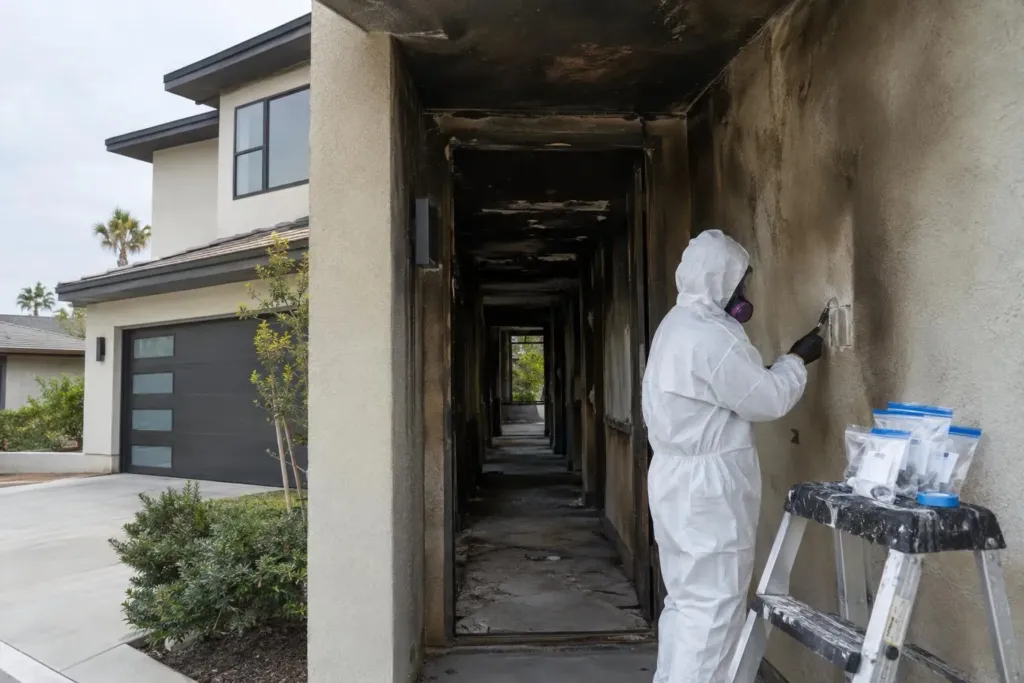
Usually, yes. Houses built before the 1980s often have asbestos in drywall joint compound, textured ceilings, flooring, and pipe wrap, and paint from before 1978 may contain lead, so testing comes before demolition.
Fire breaks these materials down and spreads them through the ash and debris. The South Coast Air Quality Management District sets the asbestos survey and notification rules for demolition and renovation in our region. Its asbestos rules for demolition explain what has to happen before walls come down.
Debris removal depends on the kind of fire. After a declared wildfire, government programs may handle cleanup in phases. The LA County Recovers site says Phases 1 and 2 of debris removal must be finished before County rebuild permits are issued. After a single-house fire, you arrange licensed removal yourself, usually through your insurance claim.
Keep your family safe while you wait. Don’t sift through ash with bare hands, don’t sweep it dry, and keep kids and pets out of the burn area. Ash can hold heavy metals as well as asbestos, and a properly protected crew should handle it.
How do I check a fire damage contractor and avoid payment traps?
Look up the license on the Contractors State License Board website, confirm it's active and covers the work, and confirm the company is insured. California treats a disaster rebuild as a home improvement project, so home improvement contract and payment rules protect you.
The CSLB Disaster Help Center explains that contractors must follow all home improvement contract and payment rules on a disaster rebuild, not treat it as new construction. Those rules limit how much a contractor can collect up front and require a written contract. Read the board’s current rules before you sign.
Watch for warning signs. Be careful with someone who knocks on your door right after the fire, asks you to sign over your insurance check, wants a large cash deposit, or says you don’t need permits. CSLB warns that contracting without a license in a declared disaster area can bring felony charges.
Ask every contractor the same questions. How will they document hidden damage once walls are open? Who pulls the permits? How are payments tied to work that’s actually finished? The answers tell you whether they plan to rebuild the house once, correctly.
When should I call a licensed contractor after a house fire?
Call once officials let you back on the property and you need board-up, a roof cover, or drying. Call before anyone starts demolition, because the first walk-through decides how much of the house can be saved. Bring in a licensed contractor when the insurer’s scope doesn’t match what you see, when opened walls reveal charred or wet framing, or when you’re unsure whether you’re facing a repair or a full rebuild. Villa Bella Construction is licensed and insured, and we start by finding the real extent of the damage so the repair fits the problem and the building department can approve it.
“If you want an honest, licensed contractor in the LA area, I highly recommend them!” — Robert H., Google review
Villa Bella Construction is a licensed and insured general contractor, building in Los Angeles for 25 years. CSLB License #1093648 (B – General Building).
Call +1 (323) 825-9798 or send us your project details.
Learn more: Fire damage rebuilding.
Planning a construction or remodeling project in Los Angeles?
Schedule a Free On-Site Consultation or call +1 (323) 825-9798.