
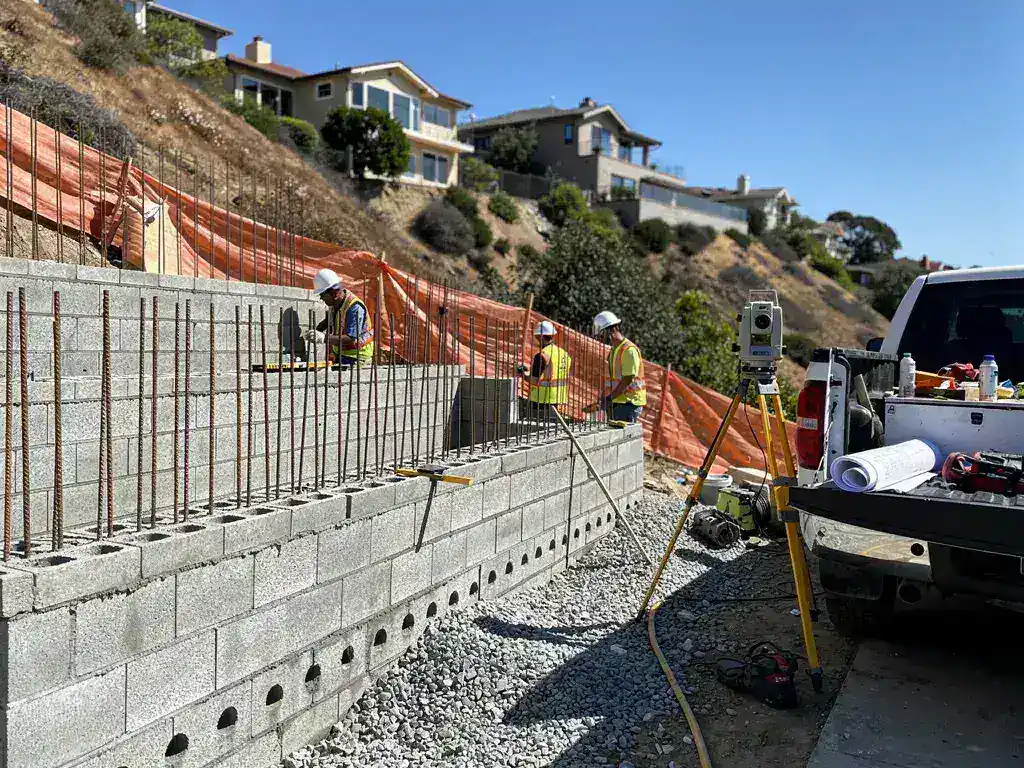
Los Angeles hillside construction demands precise engineering and strict regulatory compliance. Whether you’re installing a CMU retaining wall to stabilize a sloped property in Sherman Oaks or constructing a freestanding perimeter block wall in Silver Lake, understanding LADBS permit requirements, structural specifications, and drainage protocols is non-negotiable. The City of Los Angeles enforces rigorous standards for both load-bearing hillside retaining walls and non-structural boundary walls, with distinct permitting pathways, engineering documentation, and inspection schedules. This technical guide examines the structural engineering, rebar placement, drainage systems, and LADBS approval processes that govern CMU wall construction across Greater Los Angeles hillside neighborhoods.
Key Takeaways
- LADBS requires building permits for retaining walls exceeding 3 feet in height; boundary walls typically need permits when exceeding 6 feet or located in public right-of-way setbacks.
- Hillside retaining walls demand engineered drainage systems with 4-inch weep holes spaced every 8 feet horizontally and gravel backfill to prevent hydrostatic pressure failures.
- Structural footings must extend minimum 18 inches below grade with #4 rebar at 16-inch centers, embedded in 3,000 PSI concrete for seismic stability.
- Soils reports become mandatory for walls exceeding 6 feet in height or when constructed on slopes greater than 15 percent gradient.
- Upgrading failing wood retaining walls to reinforced CMU systems requires full LADBS plan check, geotechnical analysis, and structural engineering stamps.
LADBS Permit Requirements: Retaining Walls vs. Boundary Walls
The Los Angeles Department of Building and Safety distinguishes between two primary wall classifications: structural retaining walls that resist lateral soil pressure and non-structural boundary walls that serve property demarcation. This distinction determines permit complexity, engineering requirements, and inspection protocols. Retaining walls exceeding 3 feet in exposed height trigger mandatory building permits under LAMC Section 91.106.1, requiring structural calculations, foundation details, and drainage plans. The permit application process typically extends 6 to 12 weeks depending on plan check workload and engineering revisions.
Freestanding CMU perimeter walls present different regulatory thresholds. Boundary walls under 6 feet in height generally qualify for over-the-counter permits without engineered drawings, provided they maintain required setbacks from property lines and public rights-of-way. However, walls exceeding 6 feet, located within hillside grading areas, or constructed with decorative pilasters require full structural engineering documentation. Our team of Los Angeles concrete block wall contractors manages the entire LADBS permitting workflow, from initial plan submission through final inspection approval, ensuring compliance with both structural and zoning requirements.
Permit Documentation and Engineering Stamps
LADBS requires specific documentation packages for CMU wall permits. Structural retaining walls demand California-licensed civil or structural engineer stamps, including foundation details showing rebar placement, footing dimensions, and soil bearing capacity calculations. The submittal package must include site plans with topographic elevations, cross-sectional wall details at 1:10 scale, and drainage system specifications. Boundary wall permits require plot plans showing setback distances, wall heights at 10-foot intervals, and pilaster spacing if applicable. Processing fees range from $800 to $3,500 depending on wall length and structural complexity.
Hillside Retaining Wall Drainage: Preventing Hydrostatic Pressure Failures
Hydrostatic pressure represents the primary failure mechanism in Los Angeles hillside retaining walls. When groundwater accumulates behind wall structures without adequate drainage pathways, lateral forces can exceed design loads by 300 to 500 percent during winter rainy seasons. Proper drainage engineering requires integrated systems combining weep holes, gravel backfill, and perforated drain pipes to channel water away from wall foundations. The Concrete Masonry and Hardscapes Association publishes detailed technical standards for retaining wall drainage that inform Los Angeles engineering practices.
Effective drainage systems incorporate 4-inch diameter weep holes positioned 12 inches above finish grade, spaced horizontally every 8 feet along wall length. Behind the CMU block face, contractors install 18-inch-wide gravel zones using 3/4-inch crushed rock, creating permeable pathways for water migration. Perforated 4-inch PVC drain pipes embedded in gravel at footing level collect groundwater and direct flow to approved discharge points, preventing saturation of retained soils. This triple-redundant approach reduces hydrostatic pressure to negligible levels even during 100-year storm events common in Hollywood Hills and Encino neighborhoods.
Geotextile Fabric and Backfill Specifications
Non-woven geotextile fabric separates gravel drainage zones from native soils, preventing fine particle migration that clogs drainage pathways over time. Fabric specifications require minimum 8-ounce weight per square yard with 95 percent water flow retention after 500 hours of soil contact. Backfill materials must meet ASTM D2487 classification as GP (poorly graded gravel) or GW (well-graded gravel) with less than 5 percent fines passing the No. 200 sieve. Proper compaction to 90 percent relative density in 8-inch lifts ensures long-term soil stability and prevents settlement-induced wall cracking.
Rebar and Footing Specifications for Structural Integrity
Reinforced concrete footings form the structural foundation for all CMU retaining walls in Los Angeles. LADBS engineering standards mandate minimum footing widths equal to wall height divided by 2, with 18-inch minimum depth below undisturbed native grade. For a typical 6-foot retaining wall, this requires a 36-inch-wide by 18-inch-deep continuous footing. Concrete mix designs must achieve minimum 3,000 PSI compressive strength at 28-day cure, with 4-inch slump for proper consolidation around reinforcing steel.
Rebar placement follows strict seismic engineering protocols. Footings receive #4 (1/2-inch diameter) rebar in continuous runs, positioned 3 inches from bottom surface and spaced 16 inches on center. Vertical rebar extends from footings into CMU block cores at matching 16-inch spacing, creating integrated structural frames. Horizontal bond beams at 4-foot vertical intervals receive additional #4 rebar, with all intersections tied using 16-gauge steel wire. This reinforcement matrix resists both lateral soil loads and seismic ground motion, critical for hillside installations in Sherman Oaks and Silver Lake where slopes exceed 25 percent gradient.
CMU Block Selection and Grout Specifications
Standard 8x8x16-inch CMU blocks provide optimal strength-to-weight ratios for Los Angeles retaining walls. Blocks must meet ASTM C90 Grade N specifications with minimum 1,900 PSI compressive strength. Cells containing vertical rebar require complete grouting using 2,500 PSI grout mix, ensuring monolithic structural behavior. For walls exceeding 8 feet in height, engineers may specify 10-inch or 12-inch blocks to increase lateral load resistance. All blocks receive dampening prior to grout placement, preventing premature moisture absorption that compromises grout strength development.
Managing Soil Instability with Engineered CMU Systems
Los Angeles hillside soils present significant engineering challenges, ranging from expansive clays in Pasadena to collapsible silts in Glendale. Concrete masonry retaining walls provide permanent solutions when properly engineered for site-specific soil conditions. Geotechnical investigations determine soil bearing capacity, expansion potential, and groundwater depth—critical parameters for foundation design. Typical hillside soils support 1,500 to 2,500 PSF bearing pressure, requiring footing width calculations that distribute wall loads below allowable limits.
Expansive soils with plasticity indices exceeding 30 demand special engineering considerations. These clays can generate uplift pressures exceeding 5,000 PSF during wet cycles, potentially heaving wall foundations. Mitigation strategies include deepened footings extending below the active moisture zone (typically 4 to 6 feet depth), moisture barriers isolating footings from expansive materials, and gravel blankets providing capillary breaks. Before beginning any excavation work, contractors must contact Call 811 to identify underground utilities and prevent service disruptions during construction.
When LADBS Requires Soils Reports for Retaining Walls
The Los Angeles Building Code mandates geotechnical investigation for specific retaining wall scenarios. Walls exceeding 6 feet in total height automatically trigger soils report requirements under LAMC Section 91.1803.5.1. Additionally, any wall constructed on slopes greater than 15 percent gradient requires geotechnical analysis regardless of wall height. Properties located within designated hillside grading areas, landslide zones, or liquefaction hazard zones face mandatory soils investigation even for shorter walls.
Comprehensive soils reports include subsurface exploration via hand augers or mechanical borings to depths of 1.5 times the wall height, laboratory testing of soil samples for classification and engineering properties, and specific foundation recommendations. Geotechnical engineers provide allowable bearing pressure values, footing depth requirements, drainage specifications, and seismic design parameters. Report preparation typically requires 3 to 4 weeks after field investigation, with costs ranging from $2,500 to $6,000 depending on site access and boring depth requirements. LADBS plan checkers scrutinize soils reports during permit review, often requesting clarifications or additional testing before approval.
Field Note: Hollywood Hills Slope Stabilization Project
In 2023, our team completed a complex hillside retaining wall replacement in the Hollywood Hills involving a failing 45-foot-long wood timber wall on a 38 percent slope. The existing structure showed 14 inches of lateral displacement and active soil movement threatening the main residence. Geotechnical investigation revealed saturated silty clay soils with zero bearing capacity in the failure zone. Our engineering solution specified a 7-foot-tall reinforced CMU wall with 42-inch-wide by 24-inch-deep footings keyed into competent bedrock. The design incorporated 72 linear feet of perforated drain pipe, 18 cubic yards of crushed rock backfill, and #5 rebar at 12-inch centers for enhanced seismic resistance. LADBS permit processing extended 9 weeks due to additional geotechnical review requirements for the steep slope location. Construction required temporary shoring, controlled excavation in 4-foot sections to maintain slope stability, and concrete placement via pump truck due to site access limitations. The project achieved final inspection approval after 11 weeks of construction, with total engineering and permitting costs representing 28 percent of the $87,000 contract value.
Repairing Failing Wood Retaining Walls: The CMU Block Upgrade
Wood retaining walls deteriorate rapidly in Los Angeles climates, with average service lives of 15 to 25 years before structural failure. Pressure-treated timbers suffer moisture damage, insect infestation, and connection failure as galvanized hardware corrodes. Property owners facing failing wood walls require permanent upgrades to reinforced CMU systems that provide 75 to 100-year service lives with minimal maintenance. The replacement process involves complete demolition of existing structures, soil stabilization during construction, and installation of engineered concrete masonry walls meeting current LADBS standards.
Upgrading wood walls to CMU construction requires full building permits including structural engineering plans. Engineers evaluate existing soil conditions, analyze increased wall loads from taller CMU structures, and design foundations appropriate for site constraints. Many wood wall replacements occur on properties with limited access, requiring specialized equipment like mini-excavators and concrete buggies for material placement. The construction sequence begins with temporary shoring to prevent slope failure during demolition, followed by controlled excavation for new footings, rebar placement and inspection, concrete placement, CMU block installation with continuous grouting, and backfill compaction with integrated drainage systems.
Cost Analysis: Wood vs. CMU Retaining Walls
Initial construction costs for CMU retaining walls exceed wood alternatives by 40 to 60 percent, but lifecycle economics strongly favor concrete masonry. A typical 6-foot-tall by 30-foot-long wood retaining wall costs $8,500 to $12,000 installed, while equivalent CMU construction ranges from $14,000 to $19,000 including engineering and permits. However, wood walls require replacement every 20 years, while properly engineered CMU walls function for 75+ years without major repairs. Over a 75-year period, wood wall lifecycle costs exceed $35,000 in present-value dollars versus $19,000 for CMU construction—an 84 percent savings favoring concrete masonry systems.
Frequently Asked Questions
How long does LADBS permit approval take for a CMU retaining wall in Los Angeles?
Standard permit processing requires 6 to 12 weeks from initial submittal to approval, depending on plan check workload and engineering complexity. Projects requiring soils reports, located in hillside grading areas, or exceeding 8 feet in height typically experience longer review periods of 10 to 16 weeks. Expedited plan check services reduce timelines to 4 to 6 weeks for additional fees of $1,200 to $2,800.
What is the minimum footing depth required for retaining walls in Los Angeles?
LADBS requires minimum 18-inch footing depth below undisturbed native grade for standard retaining walls under 6 feet in height. Walls exceeding 6 feet, constructed on slopes, or located in expansive soil areas require geotechnical investigation to determine appropriate footing depths, which typically range from 24 to 48 inches depending on soil bearing capacity and frost depth considerations.
Can I build a CMU boundary wall without a permit in Los Angeles?
Freestanding boundary walls under 6 feet in height and located outside required setbacks may qualify for permit exemptions under specific conditions. However, walls within hillside grading areas, located in public right-of-way setbacks, or incorporating structural pilasters require building permits regardless of height. Unpermitted construction risks enforcement action, mandatory removal, and complications during property sales or refinancing.
Villa Bella Construction delivers turnkey CMU retaining wall and boundary wall solutions throughout Greater Los Angeles, managing all aspects from geotechnical investigation through final LADBS inspection approval. Our licensed structural contractors bring 25+ years of hillside construction expertise to properties in Beverly Hills, Pasadena, Santa Monica, and surrounding communities. Contact our engineering team today for a comprehensive site evaluation and detailed project estimate for your retaining wall or perimeter wall construction needs.
