Key Takeaways
- Firefighting water collects below and beside the burned room, in ceilings, subfloors, wall insulation, crawl spaces, and behind cabinets.
- Use moisture meters to confirm what's wet, then open those areas. A surface that looks dry can hide soaked wood.
- Keep the power off until an electrician checks it. Don't close walls until the wood is dry and the city inspector has seen the repairs.
To find water damage after house fire, look below and around the burned area, not just at it. Check the ceilings under the fire, the floors and subfloor, the wall insulation, and the crawl space. Firefighting water runs downhill and soaks into places you can’t see. Confirm what’s wet with moisture meters, keep the power off until an electrician checks the system, and don’t let anyone close the walls until the wood is dry and the city has inspected the repairs.
Where does firefighting water hide in a house?
Firefighting water follows gravity, so it ends up below and beside the fire. The usual hiding places are ceiling cavities under the burned room, the subfloor, insulation inside walls, the crawl space, and the gaps behind cabinets and built-ins.
Firefighters put a lot of water on a fire, and they also spray nearby rooms to stop it from spreading. That water doesn’t stay where it lands. It runs through floor gaps and around pipes, then soaks into anything absorbent on its way down.
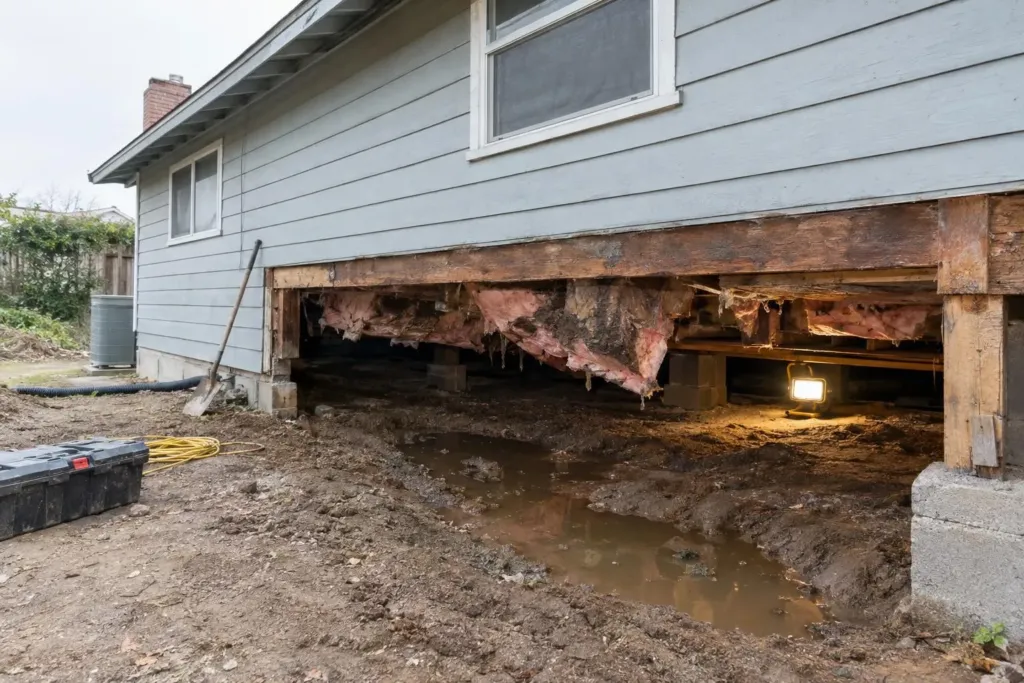
Many older Los Angeles homes sit on raised wood floors over a crawl space, the shallow open area between the ground and the first floor. In these houses, water drips through the subfloor (the plywood or boards under your finished flooring) and pools on the dirt below. It can sit there for weeks because the space gets little air.
Houses on a concrete slab have a different problem. Water spreads under the flooring and wicks into the bottom boards that the wall studs stand on. Cabinets, bathtubs, and built-in bookcases also trap water underneath, where nobody looks.
The water is also dirty. It has mixed with soot, ash, and burned debris, so treat anything it soaked as contaminated, not just damp.
What signs of water damage after a house fire can I spot myself?
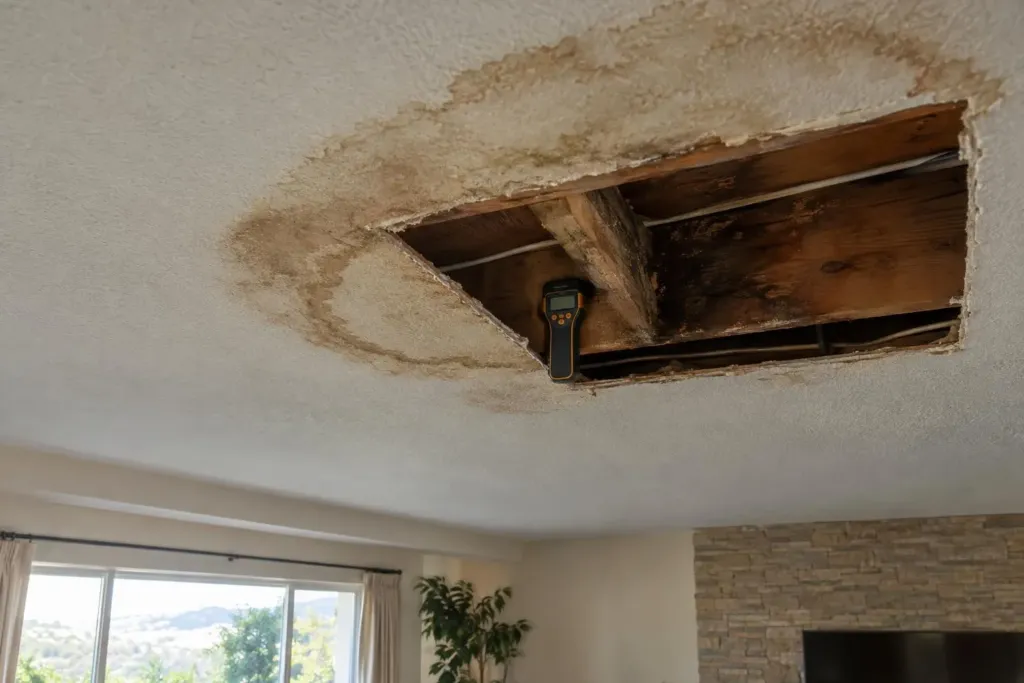
Look for sagging or stained ceilings, cupped or warped floors, soft drywall near the baseboards, bubbling paint, sticking doors, and a musty smell. Surface signs miss a lot, though, so moisture meters and thermal imaging are needed to find water inside walls and floors.
Once the fire department releases the house and it’s safe to enter, walk the rooms below and beside the fire first. Watch for these clues:
- Brown rings or a soft bulge in the ceiling
- Wood floors that cup, with board edges rising higher than the centers
- Drywall that feels soft or crumbles at the bottom
- Paint or wallpaper that bubbles or peels
- Doors and drawers that suddenly stick
- A musty or sour smell under the smoke odor
The smoke smell covers that musty odor, and a painted wall can look fine while the inside is soaked. That’s why a good assessment uses tools. A moisture meter reads how much water is inside wood or drywall. A thermal camera shows damp areas behind a surface as cooler colors.
Readings should be written down room by room, with photos of the meter on the wall. That record guides what gets opened, and it supports your insurance claim later. Our article on a fire-damaged home inspection explains what else a full walkthrough should cover.
How fast does a wet house need to dry to avoid mold?
The EPA's guidance is to dry the home and its contents within 24 to 48 hours. If that didn't happen, assume mold may be growing and plan to find it and clean it, not just air the house out.
The EPA’s mold cleanup guide for homeowners after disasters says that if things weren’t dried within 24 to 48 hours, you should assume mold is growing. That’s a planning target, not a precise clock. Mold may show up sooner or later depending on the material, the temperature, and how wet it got.
After a fire, houses rarely get dried that fast. The investigation, boarded-up windows, and a shut-off power supply keep the house closed and damp. Los Angeles air is dry, so surfaces may feel dry within days, but the inside of a wall or a soaked crawl space stays wet much longer.
A sound drying process usually goes like this:
- Remove standing water and soaked items like carpet, pad, and loose insulation.
- Open wet ceilings and walls so air can reach the cavities.
- Run dehumidifiers and air movers on safe temporary power.
- Take moisture readings daily and record them.
- Clean any mold found, then confirm the wood is back to normal dryness before rebuilding.
Painting or caulking over mold won’t stop it, according to the EPA. The same guide says mold sampling usually isn’t needed. If you can see or smell it, clean it and fix the moisture source.
Is it safe to turn the power back on after the house got wet?
Not until a licensed electrician has checked the system. Many electrical parts that got wet have to be replaced, not just dried, because restoring power too early can start another fire or cause a shock.
Water and soot get inside breakers, outlets, and junction boxes. Those parts can look fine once they dry, but corrosion and residue stay inside. The Electrical Safety Foundation International guidance on water-damaged electrical equipment says water-damaged breakers, fuses, receptacles, outlet and junction boxes, and GFCI and AFCI devices must be replaced.
That includes the shock-protection outlets with test buttons near your sinks and the breakers that guard against arcing in the wiring. Once they’ve been soaked, they’re on the replace list.
Older Los Angeles homes often have a mix of wiring from different decades. Wet older wiring, especially with brittle or cloth-covered insulation, may need to be replaced along whole runs, not just at one outlet. Your electrician will tell you what the system needs.
Until then, keep the main breaker off and use temporary power from the utility or a properly set-up source for drying equipment. Rewiring after a fire is permitted work, so it gets inspected before walls close.
Could firefighting have damaged my water lines, drains, or gas lines?
Yes. Falling debris, heavy hoses, heat, and crews moving through the house can crack or crush pipes, and some keep leaking quietly after the fire is out. A licensed plumber should pressure-test the lines, and the gas system should be checked before anything gets relit.
A slow leak inside a wall or under a floor looks a lot like leftover firefighting water. If one area stays wet while the rest of the house dries, suspect a damaged pipe. Common trouble spots are supply lines in the attic, cast-iron or clay drains in the crawl space, and connections behind toilets and sinks.
A pressure test is simple. The plumber closes off the system, adds pressure, and watches a gauge to see if it holds. If the pressure drops, there’s a leak somewhere, even if you can’t see it yet. Drains can be checked with a camera run through the pipe.
The water heater needs its own check. Heat, water, and debris can damage the burner, the controls, the venting, or the gas connector. Gas leaks are a serious risk, so let SoCalGas or a licensed plumber inspect the gas lines and appliances before anyone turns the gas back on or relights a pilot.
Don’t relight anything yourself, even if the appliance looks untouched. You can’t see smoke or heat damage inside a gas valve.
Is my wet subfloor and framing still structurally sound?
Solid framing that got wet but didn't burn or rot usually dries out and keeps its strength. Subfloor that swelled or came apart in layers, and wood that is soft, charred, or sagging, usually needs replacing, and a structural engineer should look at anything that carries real load.
Floor joists are the boards that hold up your floor. A joist that got wet but stays firm and straight can often stay once it dries. A joist that feels soft when you press a screwdriver into it, or one that has started to sag, is a different story.
Subfloor is where trouble shows up most. Plywood and OSB, the sheets made of pressed wood chips, can swell, bubble, and split into layers after a soaking. Once that happens, the sheet won’t hold nails well or stay flat under new flooring. Older homes with plank subfloors fare a little better, but rot hides at the joints and near plumbing.
Call a licensed structural engineer when wet framing is also charred, when beams or posts in the crawl space look damaged, or when floors bounce or sag. You can confirm an engineer’s license through the license lookup on the California Board for Professional Engineers, Land Surveyors, and Geologists website.
For a closer look at that decision, read our guide to fire-damaged framing repair.
Which wet materials have to come out, and what can be dried in place?
Wet insulation, soaked carpet and pad, and drywall that is soft, stained, or moldy usually come out. Solid framing, concrete, and some plaster can often be dried in place, and older homes need lead and asbestos testing before anything gets opened.
Here’s how it usually shakes out, though the house’s actual condition decides:
- Usually removed: wet insulation, carpet and pad, soft or moldy drywall, swollen particleboard cabinets, and subfloor that has come apart in layers.
- Often dried in place: solid framing, concrete slabs and foundations, hardwood that hasn’t cupped badly, and plaster that stays firm and attached.
Insulation is the easy call. Once fiberglass or cellulose soaks up dirty water, it holds that water against the wood and stays contaminated. A common approach for wet drywall is to cut a clean strip above the waterline so the cavity can dry and be inspected, without gutting the whole room.
Many Los Angeles homes were built before 1978. Their paint may contain lead, and plaster, flooring, and ceiling texture may contain asbestos. Test before opening walls. Lead-safe work falls under the EPA’s renovation rules, asbestos removal falls under South Coast AQMD notification rules, and Cal/OSHA sets worker protections. Don’t assume a newer house is clear without testing.
A crew focused on fire damage rebuilding should explain what’s coming out and why before the demolition starts.
Do I need a permit, and can walls be closed before the inspector comes?
Repairs to framing, wiring, and plumbing need permits. In the City of Los Angeles, LADBS offers express permits for limited fire-damage repair, while bigger jobs go through plan check. Work covered by the permit must stay open until the inspector has seen it.
The LADBS express permit list covers some minor residential fire-damage repair, replacement of damaged framing, water and dry-rot repair, and repair of damaged wiring. These permits don’t need drawings, but each one has size limits tied to the building’s value, so confirm with LADBS that your job fits. Larger repairs go through plan check, where the city reviews drawings before work starts.
The same LADBS document says some work has to stay uncovered until a field inspector checks it. That matters a lot here. If a crew closes up wet framing or new wiring before the inspection, the inspector can make you open it again. Worse, you could seal moisture inside the wall.
The building department decides approvals and inspection timing, so build that into your plan. If you’re outside the City of Los Angeles, your own city’s building department sets the rules. The fee waivers and fast-track programs created for the January 2025 wildfires don’t apply to an ordinary house fire.
Bigger repairs can trigger code upgrades. See our article on whether you have to rebuild to current code after a fire.
Will insurance pay for hidden water damage, and how do I document it?
It depends on your policy. Firefighting water is usually handled as part of the fire claim, but mold limits and exclusions vary, so read the policy and document everything before anything is torn out.
Adjusters can’t pay for damage they never saw. Once a wall is gutted, the proof is in a dumpster. Document hidden water damage after house fire like this:
- Get a full copy of your policy, including any mold limits.
- Photograph and video every room before demolition, including the ceilings and floors.
- Record moisture meter readings with the meter visible in each photo.
- Photograph cavities as they’re opened, showing the wet insulation and framing.
- Keep samples of damaged material if your adjuster asks for them.
- Confirm every agreement with the adjuster in writing.
Additional Living Expense, often called ALE, pays the extra cost of living elsewhere while the house is unlivable. It has limits, so track what you spend against them. The California Department of Insurance disaster insurance guidebook explains ALE, warns about scams, and lists the CDI help line if your claim stalls.
Some extended ALE protections in California are tied to declared emergencies, so don’t count on them for a single house fire. Ask your insurer what applies to your claim.
When should I call a licensed contractor about water damage after a fire?
Call a licensed contractor once moisture readings show wet framing or subfloor, when floors feel soft or ceilings sag, or when repairs will need a permit. Call before anyone closes a wall. A good contractor coordinates the electrician, plumber, engineer, and testing so the house dries fully, the work gets inspected, and the repair is done once.
Before you sign anything, check the contractor’s license on the Contractors State License Board website, and be wary of anyone who knocks on your door right after a fire asking for a large deposit. Villa Bella Construction is licensed and insured and focuses on finding the real extent of the damage, then making targeted repairs built to be ready for city inspection.
“Steve was easy to work with and was very responsive.” — Bill M., Yelp review
Villa Bella Construction is a licensed and insured general contractor, building in Los Angeles for 25 years. CSLB License #1093648 (B – General Building).
Call +1 (323) 825-9798 or send us your project details.
Learn more: Fire damage rebuilding.
Planning a construction or remodeling project in Los Angeles?
Schedule a Free On-Site Consultation or call +1 (323) 825-9798.