Concrete Driveway Repair in Los Angeles: Fix It or Replace It?
Key Takeaways
– Most concrete driveway repair starts with finding *why* the concrete cracked. Common causes are soil movement, water, tree roots or a weak base, and fixing only the surface rarely lasts.
– Thin, stable cracks can be sealed. Sunken, lifted or badly broken sections usually need lifting or partial replacement, and full replacement is only needed when the damage is widespread.
– Work in the public right-of-way, foundation repairs and drainage changes usually need permits. The city building department, not the contractor, decides approvals and inspection timing.
Concrete driveway repair works when you fix the cause, not just the crack. If you seal a crack without dealing with the water, roots or soil movement underneath, it’ll usually come back, often wider. The good news is that most damaged driveways and slabs don’t need to be torn out completely. A careful look at what’s happening below the surface tells you whether you need a simple seal, a section replaced or something bigger.
Here are the questions Los Angeles homeowners ask most about driveways and slabs, with straight answers.
—
Why Is My Concrete Driveway Cracking?
Concrete cracks because the ground under it moves, water washes out its support, or it was built without enough base, reinforcement or joints. In Los Angeles, the usual culprits are clay soil, tree roots and poor drainage.
All concrete shrinks a little as it cures. *Curing* is the period after a pour when the concrete hardens and gains strength. That shrinkage is why contractors cut *control joints*, which are straight grooves that tell the concrete where to crack so it breaks in a neat line instead of randomly. If your driveway has few joints, or they were cut too shallow, you’ll see wandering cracks running between them.
Beyond normal shrinkage, these are the causes we see most often around Los Angeles:
Expansive clay soil. Expansive soil swells when it gets wet and shrinks when it dries out. Many neighborhoods across the L.A. basin and the hillsides sit on clay, so a driveway can rise a little in the rainy season and drop back in summer. Years of that movement crack slabs.
Tree roots. Ficus, pine, magnolia and other large street and yard trees send roots under concrete looking for moisture. As the roots thicken, they lift slabs and cause the classic raised edge or tented crack.
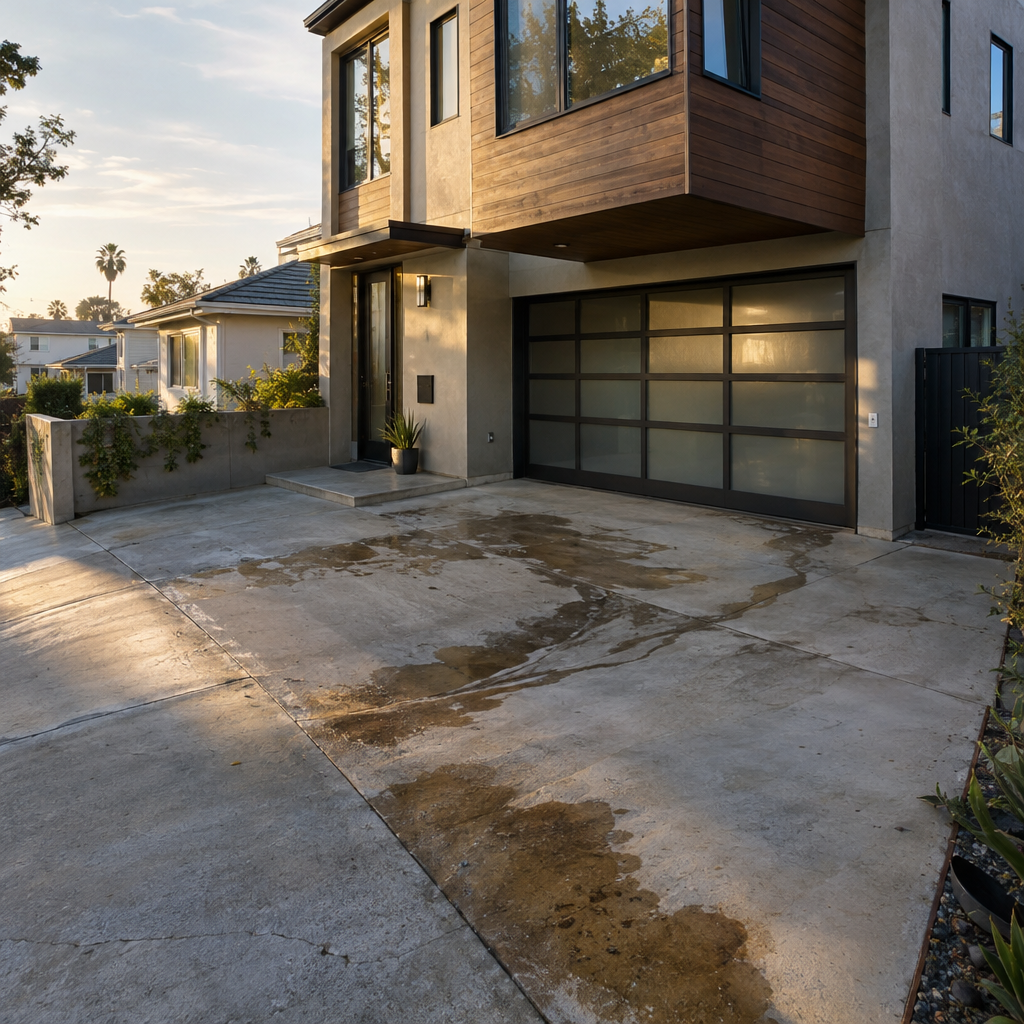
Water undermining the base. Downspouts that dump onto the driveway, sprinklers that overspray, or a slope that drains toward the slab can wash away the soil underneath. Once there’s a void, the concrete sags and breaks.
Thin concrete or a weak subbase. The *subbase* is the layer of compacted gravel or soil the slab sits on. Older driveways were sometimes poured thin, directly on loose dirt, with no gravel and little or no steel.
Heavy loads. Moving trucks, RVs and delivery vehicles put more weight on a residential driveway than it was built for, especially near the edges.
Age. A lot of driveways in older Los Angeles homes are 50 years old or more. Even good concrete wears out over that kind of span.
In older Los Angeles homes, the worst damage often shows up where the driveway meets the garage or the street. Those are the spots where water collects and where the slab changes thickness or meets another surface.
—
Which Cracks Are Normal and Which Ones Are a Real Problem?
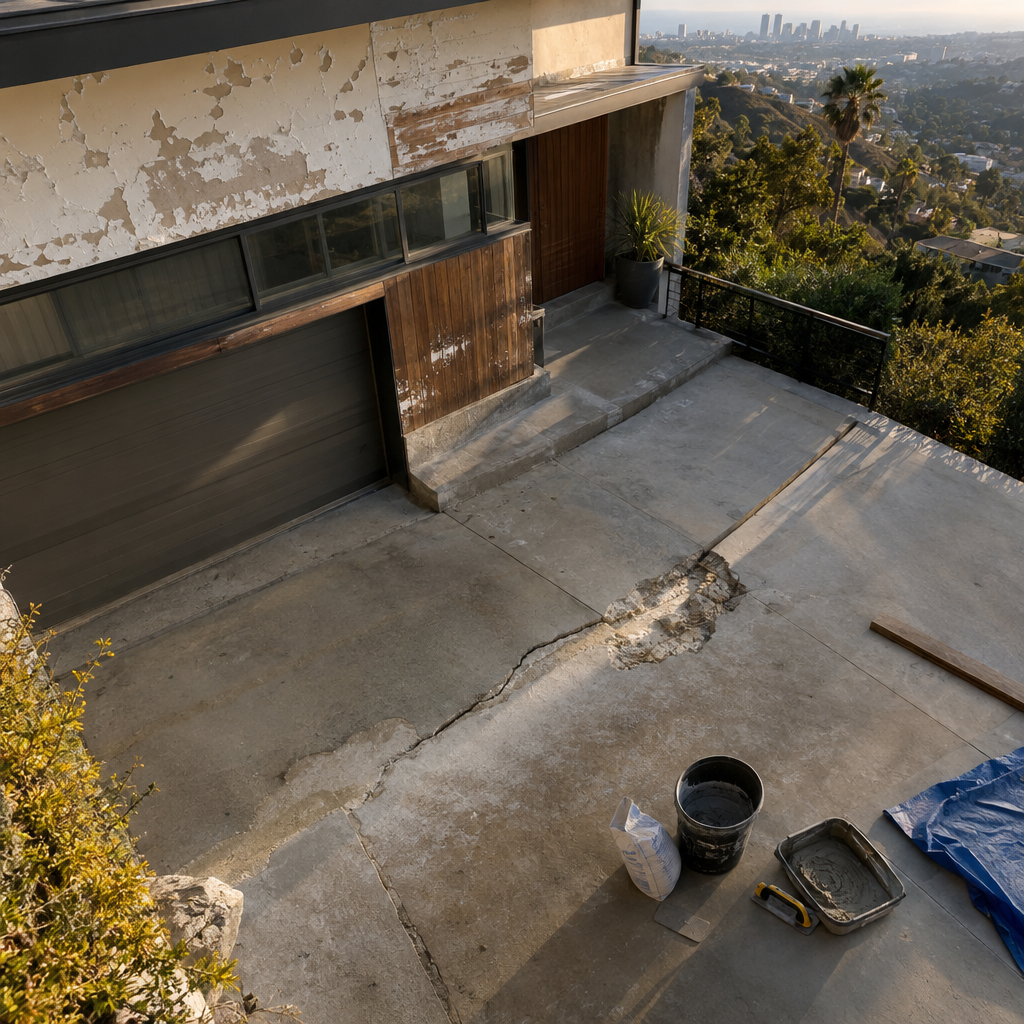
Hairline cracks that stay flat and don’t grow are usually cosmetic. Cracks wider than about a quarter inch, cracks where one side is higher than the other, and cracks that keep getting bigger point to movement underneath that needs attention.
Not every crack is an emergency. Here’s how to sort them out.
Usually cosmetic:
Thin, hairline cracks you can barely fit a fingernail into
Cracks that follow the control joints
Fine spiderweb surface cracks, called *crazing*, which form in the top layer from fast drying and don’t affect strength
Cracks that look the same year after year
Worth a closer look:
Cracks wider than a quarter inch
*Displacement*, which means one side of the crack sits higher than the other
Sections that rock or move when you drive over them
Low spots where water puddles after rain or sprinklers
Gaps opening between the driveway and the garage slab or house foundation
Soil washing out from under the slab edges
White chalky deposits called *efflorescence*, which are salts left behind when water moves through the concrete repeatedly
A simple way to track a crack: mark both ends with a pencil and write the date next to it. Measure the width with a ruler. Check it again in a few months. If it grew longer or wider, something is still moving.
Raised edges are also a trip hazard. If a slab has lifted where people walk, especially near a sidewalk or front entry, don’t wait on that one.
—
Is Concrete Driveway Repair Enough, or Do I Need a New Driveway?
Repair is usually enough when the damage is limited to a few cracks or one or two sections and the base underneath is still sound. Replacement makes sense when most of the slab is broken, sunken or crumbling, or when the base itself has failed across the driveway.
This is the question that matters most for your budget, and it’s where a lot of homeowners get pushed into more work than they need. Our approach is to find the real cause first, then recommend the safest targeted repair the city will accept. Tearing out a whole driveway because one corner sank is rarely the right answer.
Here’s how the decision usually breaks down:
Repair is often the right call when:
Cracks are narrow and the slab is still level
Damage is confined to one area, such as a corner lifted by a single tree
The rest of the concrete is solid and not flaking
The cause can be fixed at the source, for example by rerouting a downspout or cutting back a root
Partial replacement fits when:
One or more sections between control joints are badly broken or sunken
A root has to be removed and the slab above it can’t be saved
A utility line or drain under the driveway needs repair
Full replacement is usually justified when:
Cracks run across most of the driveway
The surface is scaling, crumbling or breaking apart everywhere
The whole slab has settled or tilted toward the house
Drainage has to be completely regraded to stop water from flowing toward the foundation
The concrete is so thin or old that patches won’t bond or hold
Keep in mind that patched concrete never matches the color of the old slab perfectly. If appearance matters to you, it’s fair to factor that in. But looks alone shouldn’t drive you to replace a structurally sound driveway.
You can see the full range of concrete work we handle on our [concrete driveways, block walls and retaining walls page](/concrete-driveways-block-walls-retaining-walls/).
—
What Repair Methods Actually Work for Driveways and Slabs?
The main options are crack sealing, slab lifting, section replacement and full replacement. The right one depends on how much the slab has moved and why. Each only lasts if the underlying cause is fixed too.