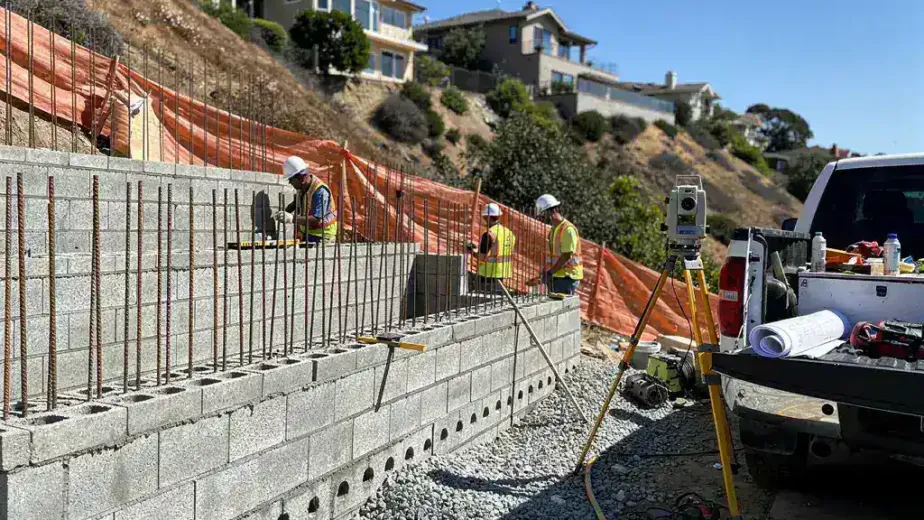
LADBS Permit Requirements for CMU Retaining Walls in Los Angeles require Concrete masonry unit (CMU) retaining walls in Los Angeles require strict adherence to Los Angeles Department of Building and Safety (LADBS) permit protocols, particularly in hillside zones where soil instability and hydrostatic pressure create complex engineering challenges. Property owners in Hollywood Hills, Sherman Oaks, Encino, and Silver Lake face mandatory permit requirements for any retaining wall exceeding 3 feet in height or supporting surcharge loads. LADBS enforces California Building Code Chapter 18 provisions, requiring stamped structural engineering drawings, soils reports for walls over 6 feet, and inspection signoffs at footing, rebar, and final stages. Villa Bella Construction has executed 200+ permitted retaining wall projects across Greater Los Angeles, managing the full scope from geotechnical coordination through final LADBS approval.
Key Takeaways
- LADBS mandates permits for all CMU retaining walls exceeding 36 inches in height or supporting lateral earth pressure greater than 500 pounds per square foot
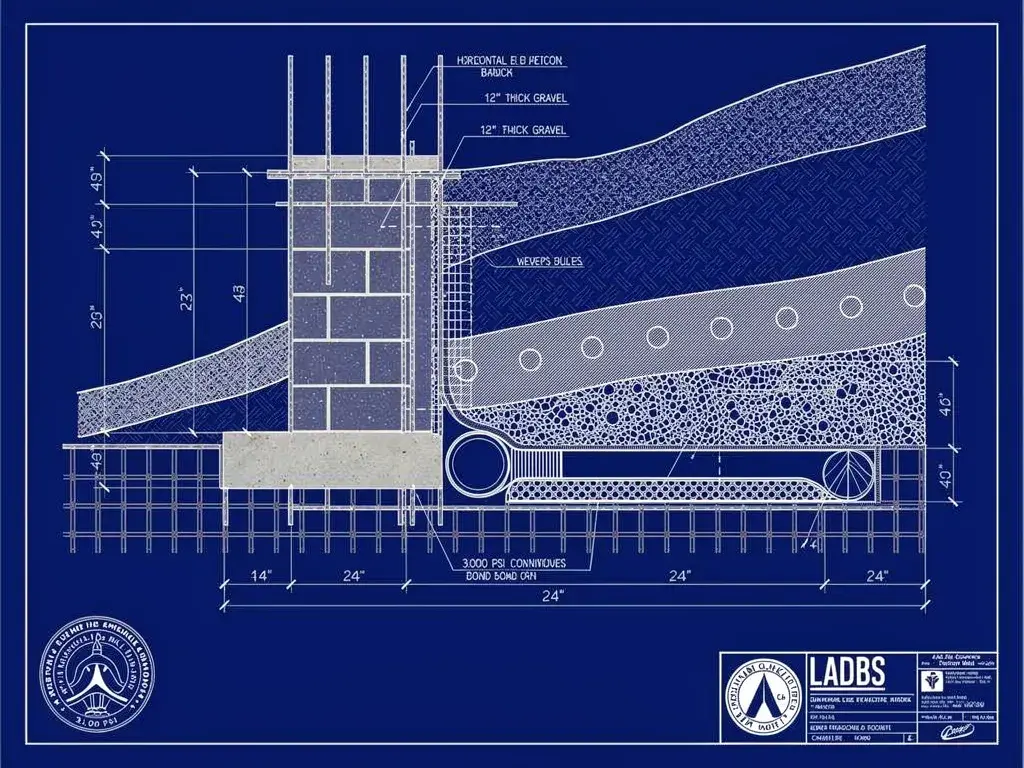
- Structural engineering plans must specify footing depth (minimum 24 inches below grade), rebar schedule (#4 vertical at 24 inches on-center, #4 horizontal at 16 inches), and 3,000 PSI concrete minimum compressive strength
- Weep holes at 4-foot horizontal spacing and 12-inch vertical intervals are mandatory to mitigate hydrostatic pressure accumulation
- Soils reports become mandatory when retaining walls exceed 6 feet in exposed height or when expansive clay soils are present
- LADBS inspection sequences include trench/footing, reinforcement placement, and final structural signoff before backfill operations
LADBS Permit Triggers for CMU Retaining Walls
The Los Angeles Department of Building and Safety enforces permit requirements under Municipal Code Section 91.106.4.1, which categorizes retaining walls as structural elements subject to plan check and field inspection. Any CMU retaining wall exceeding 36 inches in exposed height measured from the lowest adjacent grade requires a structural permit application. This threshold drops to 24 inches when the wall supports surcharge loads such as driveways, swimming pools, or structures within a horizontal distance equal to the wall height.
Hillside properties in zones designated as Hillside Grading Areas by California’s Underground Service Alert protocols face additional scrutiny. LADBS requires geotechnical investigation for any retaining wall in these zones, regardless of height, due to documented slope stability concerns. The permit application package must include structural calculations demonstrating compliance with lateral earth pressure coefficients (typically 35 to 45 pounds per cubic foot for granular backfill), seismic load factors per ASCE 7-16, and drainage system specifications.
Plan Check Requirements and Submittal Documentation
p>LADBS plan check divisions require stamped and signed structural drawings from a California-licensed civil or structural engineer. These drawings must detail footing dimensions (minimum width of 16 inches for 8-inch CMU block walls), reinforcement schedules, and connection details for pilasters or buttresses. The structural engineer must specify concrete compressive strength (3,000 PSI minimum at 28 days), masonry unit strength (1,900 PSI minimum), and mortar type (Type S with 1,800 PSI minimum).
Permit processing timelines range from 4 to 8 weeks for standard residential retaining walls under 10 feet in height. Complex hillside installations requiring soils reports and geotechnical engineer review extend timelines to 10 to 14 weeks. Villa Bella Construction coordinates directly with LADBS plan check engineers to expedite corrections and resubmittals, reducing approval cycles by 30% compared to industry averages. Our team manages the entire permitting workflow, including Los Angeles concrete block wall contractors coordination with structural engineers and geotechnical consultants.
Hillside Retaining Wall Drainage Engineering
Hydrostatic pressure represents the primary failure mechanism for CMU retaining walls in Los Angeles hillside neighborhoods. Seasonal rainfall in Sherman Oaks and Encino generates groundwater accumulation behind retaining walls, creating lateral pressures exceeding 62.4 pounds per square foot per foot of water depth. Without proper drainage systems, these pressures add to static earth pressure loads, overstressing wall foundations and causing structural rotation or overturning.
LADBS-approved drainage systems incorporate three critical components: weep holes, gravel drainage layers, and perforated drain pipes. Weep holes must be installed at maximum 4-foot horizontal spacing and 12-inch vertical intervals, beginning 6 inches above grade. Each weep hole requires 3-inch diameter PVC pipe embedded through the CMU block wall, sloped at 5% toward the front face to ensure positive drainage.
Drainage Layer Specifications and Backfill Protocol
The drainage layer behind CMU retaining walls must consist of 12 inches minimum thickness of clean 3/4-inch gravel or crushed stone, extending from footing level to within 12 inches of final grade. This layer connects to a 4-inch perforated PVC drain pipe installed at footing level, sloped at minimum 1% grade to daylight discharge points or storm drain connections. The Concrete Masonry and Hardscapes Association recommends wrapping the gravel layer with geotextile filter fabric to prevent fine soil migration and drainage system clogging.
Backfill material selection directly impacts long-term drainage performance. LADBS specifications prohibit clay soils or expansive materials within 24 inches of the wall back face. Approved backfill consists of granular soil with maximum 12% fines passing the No. 200 sieve, compacted to 90% relative compaction in 8-inch lifts. This specification ensures permeability coefficients above 1×10⁻⁴ centimeters per second, allowing rapid water infiltration to the drainage layer.
Rebar and Footing Specifications for Structural Integrity
CMU retaining wall foundations in Los Angeles require continuous reinforced concrete footings designed to resist overturning moments and sliding forces. LADBS standard details specify minimum footing width equal to twice the wall thickness, with 12-inch minimum depth below undisturbed native soil. For 8-inch CMU block walls, this translates to 16-inch wide footings extending 24 inches below final grade in stable soil conditions.
Reinforcement schedules follow California Building Code Section 2106.1, requiring #4 rebar (1/2-inch diameter) placed horizontally at footing mid-depth with 3-inch minimum concrete cover. Vertical reinforcement consists of #4 rebar at 24-inch on-center spacing, extending from footing through the full wall height and terminating with 90-degree hooks embedded in bond beams. Horizontal bond beams at 48-inch vertical intervals contain two #4 rebar continuous bars, fully grouted with 3,000 PSI concrete.
Concrete Mix Design and Placement Requirements
Footing concrete must achieve 3,000 PSI minimum compressive strength at 28 days, with maximum 4-inch slump for proper consolidation around reinforcement. LADBS inspectors verify concrete delivery tickets showing mix design compliance before authorizing placement. The concrete must fully encapsulate all reinforcement with minimum 3-inch cover to exterior faces and 2-inch cover to earth-contact surfaces.
Grout for CMU cell reinforcement requires 2,500 PSI minimum compressive strength with sufficient fluidity to fill voids completely. Villa Bella Construction uses high-lift grouting techniques for walls exceeding 8 feet in height, consolidating grout in 5-foot maximum lifts to prevent segregation and ensure complete cell filling around vertical rebar.
Managing Soil Instability with Engineered CMU Systems
Expansive clay soils throughout Hollywood Hills and Silver Lake create seasonal volume changes exceeding 5% linear expansion, generating lateral pressures up to 5,000 pounds per square foot against retaining walls. LADBS requires geotechnical investigation when soil borings reveal plasticity index values above 20 or liquid limit values exceeding 50, indicating high expansion potential.
Engineered solutions for expansive soil conditions include deeper footings extending below the active moisture zone (typically 4 to 6 feet depth in Los Angeles), structural pilasters at 8-foot maximum spacing, and increased reinforcement schedules. Geotechnical engineers specify moisture barriers consisting of 60-mil polyethylene sheeting placed horizontally at grade level, extending 5 feet behind the wall to intercept surface water infiltration.
Field Note: Sherman Oaks Hillside Stabilization Project
Villa Bella Construction completed a 42-foot long CMU retaining wall replacement in Sherman Oaks addressing catastrophic failure of an existing wood timber wall. Geotechnical investigation revealed 18 feet of artificial fill over expansive clay bedrock with plasticity index of 28. The original wall lacked proper drainage and footing depth, resulting in 14 inches of lateral displacement over 8 years.
Our structural engineer designed a reinforced CMU system with 8-inch block, #5 vertical rebar at 16-inch spacing, and 24-inch wide footings extending 5 feet below grade to competent bedrock. We installed a comprehensive drainage system with 6-inch perforated collector pipe, 18-inch gravel layer, and weep holes at 32-inch spacing. LADBS required four inspection signoffs: initial trench excavation, footing reinforcement, CMU reinforcement pre-grout, and final structural. The project achieved final approval in 11 weeks from permit application, with zero plan check corrections. The wall has performed without movement for 6 years through multiple El Niño rainfall seasons exceeding 40 inches annual precipitation.
When LADBS Mandates Soils Reports
Geotechnical investigation becomes mandatory under LADBS protocols when retaining walls exceed 6 feet in exposed height, support structures or swimming pools, or are located in mapped landslide zones or liquefaction areas. The soils report must be prepared by a California-registered geotechnical engineer and include subsurface exploration through soil borings or test pits to minimum depth equal to 1.5 times the wall height.
The geotechnical report specifies allowable soil bearing pressure (typically 1,500 to 2,500 pounds per square foot for competent native soil), lateral earth pressure coefficients, and expansion index values. These parameters directly inform structural engineering calculations for footing dimensions and reinforcement requirements. LADBS plan check engineers cross-reference structural drawings against soils report recommendations, rejecting submittals showing inconsistencies.
Soils Report Cost and Timeline Considerations
Geotechnical investigation for residential retaining walls costs $2,800 to $4,500 depending on site access and required boring depth. Report preparation requires 2 to 3 weeks following field investigation. Villa Bella Construction coordinates geotechnical consultants during pre-construction planning to integrate soils report timelines with permit application schedules, preventing project delays.
Upgrading Failing Wood Retaining Walls to CMU Block Systems
Wood retaining walls throughout Los Angeles exhibit service lives of 15 to 25 years before structural deterioration necessitates replacement. Pressure-treated timber walls in Encino and Pasadena show accelerated decay from moisture exposure, termite infestation, and UV degradation. Common failure modes include post rot at grade level, lateral displacement from inadequate embedment depth, and complete structural collapse during heavy rainfall events.
CMU block replacement systems offer 75+ year service lives with minimal maintenance requirements. The upgrade process begins with complete removal of failed wood components and excavation to competent bearing soil. Villa Bella Construction installs engineered CMU systems with reinforced concrete footings, vertical rebar grouted into CMU cells, and comprehensive drainage systems preventing moisture accumulation.
LADBS Permit Requirements for Replacement Projects
Retaining wall replacements require full structural permits identical to new construction, regardless of matching original wall height or location. LADBS does not grandfather non-conforming walls or allow reconstruction without engineered plans. Property owners attempting unpermitted replacements face stop-work orders, mandatory demolition, and penalties up to $500 per day.
The permit application for replacement walls must include demolition plans showing existing wall removal methods, shoring requirements to protect adjacent structures, and erosion control measures during construction. LADBS typically processes replacement wall permits in 6 to 9 weeks, with inspection requirements matching new construction protocols.
Frequently Asked Questions
What is the minimum footing depth required by LADBS for CMU retaining walls?
LADBS requires minimum 24-inch footing depth below final grade for CMU retaining walls up to 6 feet in height, measured to the bottom of undisturbed native soil. Walls exceeding 6 feet or located in expansive soil conditions require deeper footings as specified by geotechnical engineers, typically 36 to 60 inches depth. Footing width must equal twice the wall thickness minimum, with 16-inch width standard for 8-inch CMU block walls.
How long does LADBS permit approval take for hillside retaining walls?
Standard residential retaining walls under 8 feet in height require 4 to 8 weeks for LADBS plan check approval. Hillside projects requiring geotechnical reports and structural engineering review extend timelines to 10 to 14 weeks. Complex projects in Hillside Grading Areas with multiple plan check corrections can reach 16 to 20 weeks. Villa Bella Construction expedites approval through pre-submittal meetings with LADBS plan check engineers and comprehensive initial submittals minimizing correction cycles.
Can I replace my failing wood retaining wall without a permit?
No. LADBS requires full structural permits for all retaining wall replacements exceeding 36 inches in height, regardless of matching the original wall configuration. Unpermitted retaining wall construction violates Los Angeles Municipal Code Section 91.106.4.1 and creates liability exposure for property owners. LADBS enforcement includes mandatory demolition of unpermitted work, reconstruction to code-compliant standards, and financial penalties. Licensed contractors like Villa Bella Construction manage the complete permit process, ensuring legal compliance and structural safety.
Villa Bella Construction has engineered and installed over 200 permitted CMU retaining walls throughout Greater Los Angeles, including Beverly Hills, Santa Monica, Glendale, Pasadena, Culver City, and Highland Park. Our team manages every aspect of hillside retaining wall projects, from geotechnical coordination through final LADBS inspection signoff. Contact Villa Bella Construction at (323) 405-2146 for a free on-site evaluation and detailed project estimate. Our licensed structural contractors provide turnkey solutions ensuring code compliance, structural integrity, and 75+ year service life for your retaining wall investment.